Expectation and control
Many players increase pressure by demanding certainty from an uncertain game. When expectation hardens, the golfer starts forcing outcomes rather than responding to the shot with appropriate clarity.
Quiet the Mind, Lower the Score is the parent framework behind the book, the course, and direct golf psychology coaching. It exists for golfers who have realised that performance breakdown cannot be explained by swing mechanics alone.
When pressure rises, the problem is rarely just technical. Perception changes. Attention narrows. Tempo shifts. Identity tightens around score. The player begins to interfere with movement, decision-making, and judgment in ways that practice alone does not solve.
This section of the site brings the full framework together. You can begin with the book, study the ideas in more depth through the course, or apply them directly through one-to-one coaching. Each resource addresses the same underlying question: how do you perform with more clarity when consequence becomes real?
Many golfers search for help when they begin losing access to a game that still appears to exist in fragments. They can practise well, understand the mechanics, and still fail to trust themselves when the shot matters. The instinct is to search for another technique, another thought, or another routine. Often that only deepens the confusion.
Quiet the Mind, Lower the Score begins from a different premise. Performance in golf is not only shaped by movement skill. It is also shaped by perception, pressure response, attention, emotional state, memory of recent outcomes, and the meaning the player attaches to score. A golfer who becomes internally noisy does not simply feel worse. He begins reading the situation differently and organising his action less well.
This framework was built to explain that reality clearly. It does not promise instant calm or permanent confidence. It is designed to help serious golfers understand why performance destabilises, why understanding alone is often insufficient, and how a more organised response can be built through study, application, and direct coaching.
Many players increase pressure by demanding certainty from an uncertain game. When expectation hardens, the golfer starts forcing outcomes rather than responding to the shot with appropriate clarity.
Pressure does not only create nerves. It changes what the player notices, how risk is interpreted, and how the shot is experienced. This is why two identical golf shots can feel psychologically different.
Confidence built only on recent results is fragile. The framework examines how golfers can build something more durable by changing the basis on which trust is formed.
Performance often degrades when attention collapses inward at the wrong moment. Learning what to notice, when to notice it, and when to leave movement alone is central to better scoring.
Golf becomes heavier when every round becomes evidence about the self. The framework addresses how identity can overattach to performance and distort decision-making.
Insight that feels clear at home or on the range often dissolves on the course. Quiet the Mind is concerned with what actually transfers when consequence becomes real.
The strongest starting point for most readers. The book sets out the full argument in long form and gives the golfer a serious explanation of why pressure, noise, and self-interference emerge.
The online course deepens the material into a more structured study process. It is suitable for golfers who want extended teaching, guided audio modules, and workbook-based application.
Coaching applies the framework directly to the player. This route is for golfers who want practical diagnosis of their pressure patterns, attention shifts, decision behaviour, and performance instability.
“Just wanted to give some insights on my first game after reading Quiet the Mind, Lower the Score… Previously my demeanour while playing fluctuated between disappointment and anger. Thanks to the book and the techniques within it, today I played with an air of calm and peace... it’s changed my entire outlook on the game.”
Jim, UK golfer

A golf psychology book for serious golfers who want a deeper explanation of pressure, confidence, perception, emotional control, and performance identity.
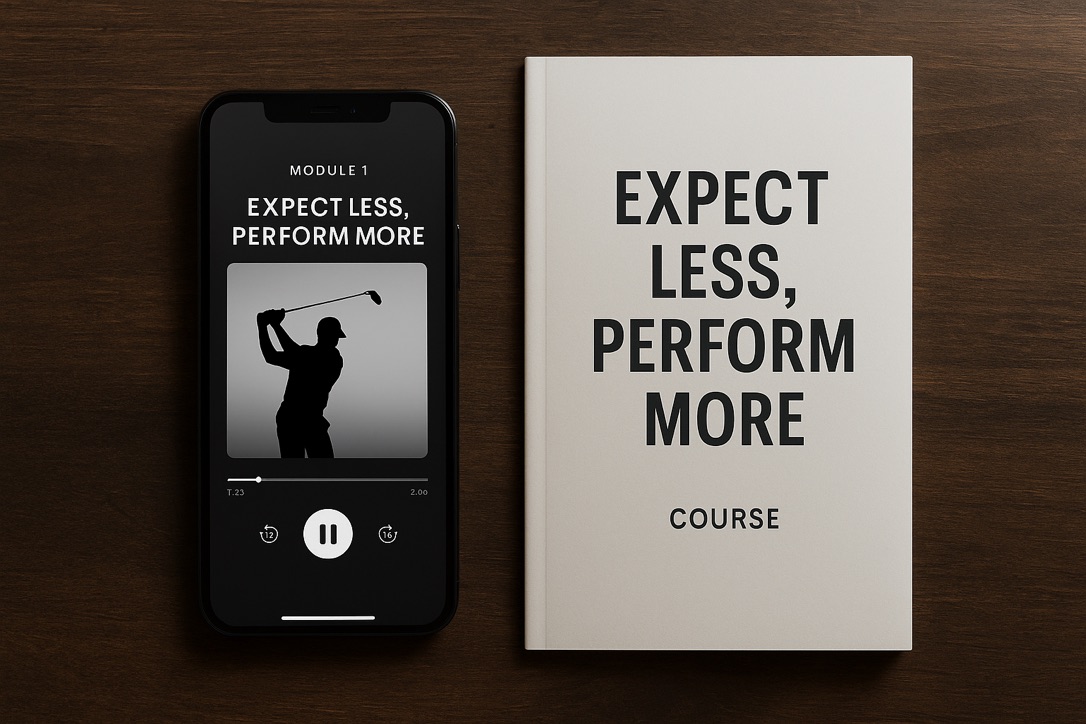
A structured digital study course that develops the ideas further through audio teaching and workbook application.

Live one-to-one coaching for golfers who want the framework applied to their own competitive patterns, emotional responses, and performance habits.

A broader topic page that places the Quiet the Mind framework inside Chris Brook’s wider work on golf psychology, performance, and scoring behaviour.
These articles help search engines and readers connect the book ecosystem to the wider knowledge base on your site.
Perception, awareness, and why visual control is often misunderstood in golf performance.
A more nuanced look at imagery, intention, and when visualisation helps or hinders the player.
Why insight and explanation do not always transfer cleanly into on-course performance.
Explore the wider article library on biomechanics, perception, psychology, and golf performance.
The purpose of this parent page is to give the section real topical weight. It should help Google and the reader understand that Quiet the Mind, Lower the Score is more than a book title. It is a performance psychology framework with connected resources and a coherent body of thought.
That is why this page should carry meaningful copy, clear internal links, and enough topical depth to stand on its own. The book, course, and coaching pages then become strong child resources supported by a more authoritative parent.
Begin with the book if you want the full philosophy in a clear written structure. Use the course if you want guided study and deeper application. Choose coaching if you want the framework applied directly to your own performance patterns.
For broader search visibility and topic support, keep this parent page closely linked to the golf psychology hub and to the psychology-related articles across the site.
Book, course, coaching, and connected articles, all built around one central aim: helping golfers understand why performance becomes unstable and how greater clarity can be built under pressure.