Part of the Chris Brook Performance Series: technical studies on how perception and internal organisation govern whether speed becomes stable or collapses into protection.
For more than a century, golfers have been taught one command above all others: “Keep your eye on the ball.” It is spoken with authority. It feels logical. It sounds irrefutable. And yet, it quietly sabotages one of the most important movements in the game.
The driver swing is not a precision tap. It is a full-body rotational act. It is explosive, elastic, and spatial. It is closer in nature to throwing, hitting, or striking than it is to placing. The human body was not designed to perform high-speed rotational tasks while the visual system is locked in narrow fixation.
That instruction does not merely influence where the eyes point. It reshapes how the nervous system organises movement. When a golfer stares at the ball, the brain interprets the task as fragile. The body responds by tightening. The head stiffens. The neck restricts. The shoulders rise. The transition shortens. The downswing rushes. What looks like a mechanical fault is, in truth, a perceptual one.
The eyes do not simply observe. They govern how the body moves through space. In every rotational sport, elite performers do not fixate on the object they are about to strike. Their vision remains soft, wide, and spatial. They operate in peripheral awareness. The reason is not mystical. It is neurological. Fixation narrows the brain’s field of safety. Peripheral vision expands it.
When the eyes lock, the body prepares to protect. When vision softens, the body is free to organise. Golf has inverted this relationship. By instructing players to stare, the game has trained millions of nervous systems to treat impact as a threat. The body does what it always does under threat. It compresses time. It guards. It rushes.
This is why so many golfers feel as though they are “snatched from the top.” It is not impatience. It is perception. The swing is being governed by the eyes.
Why a square, still head is hostile to rotation
If you stand behind a golfer at address and observe the head, you will often see a rigid square orientation. The chin is level. The face is fixed. The eyes are drilled into the back of the ball. This seems disciplined. In reality, it is geometrically hostile to rotation.
The cervical spine is not designed to remain square in a rotational task. The thorax rotates around it. The shoulders move on an inclined plane beneath it. When the head is held square and level, the neck becomes a mechanical brake. The lead shoulder has nowhere to go but up. The thorax loses depth. The arms become disconnected. The body begins to work around the head instead of through space.
A slight rotation and tilt of the head changes everything. When the head is allowed to orient subtly to the right for a right-handed golfer, and to tilt naturally, the neck no longer blocks rotation. The shoulders are free to turn on plane. The thorax can coil without resistance. The swing becomes circular rather than evasive. This is not a stylistic preference. It is anatomical truth.
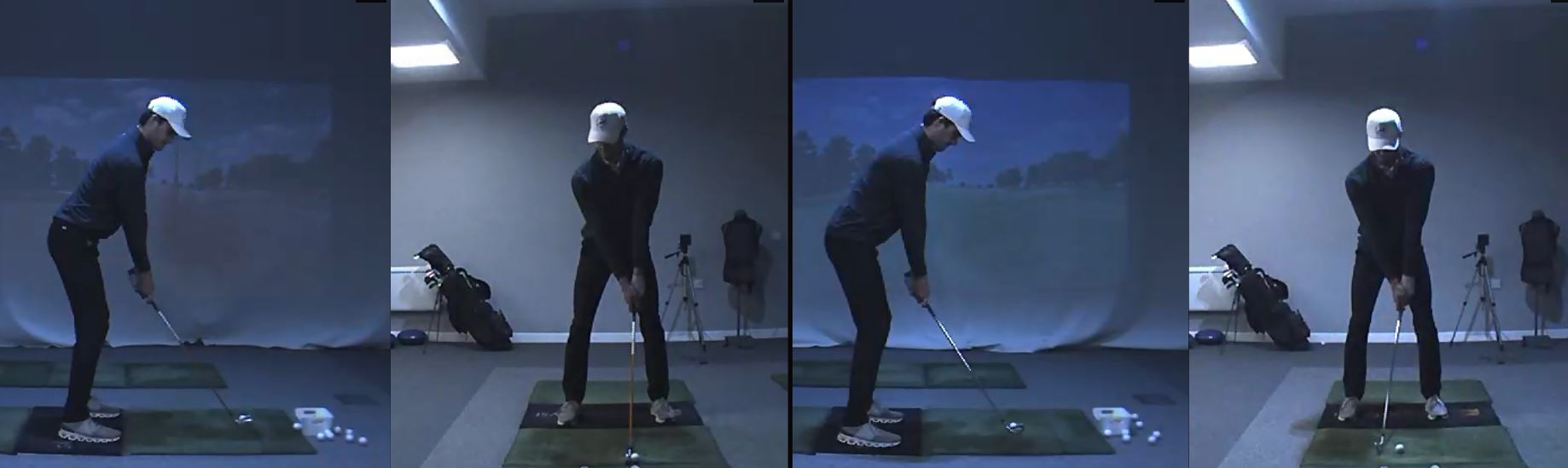
The 2 o’clock relationship and why peripheral vision matters
More importantly, that head geometry changes how the eyes relate to the ball. Instead of being stared at, the ball moves into what can be described as a “2 o’clock” visual relationship. It is no longer the centre of attention. It sits within peripheral awareness. The eyes are not closed. The ball is not ignored. It is simply no longer treated as a fragile object that must be guarded.
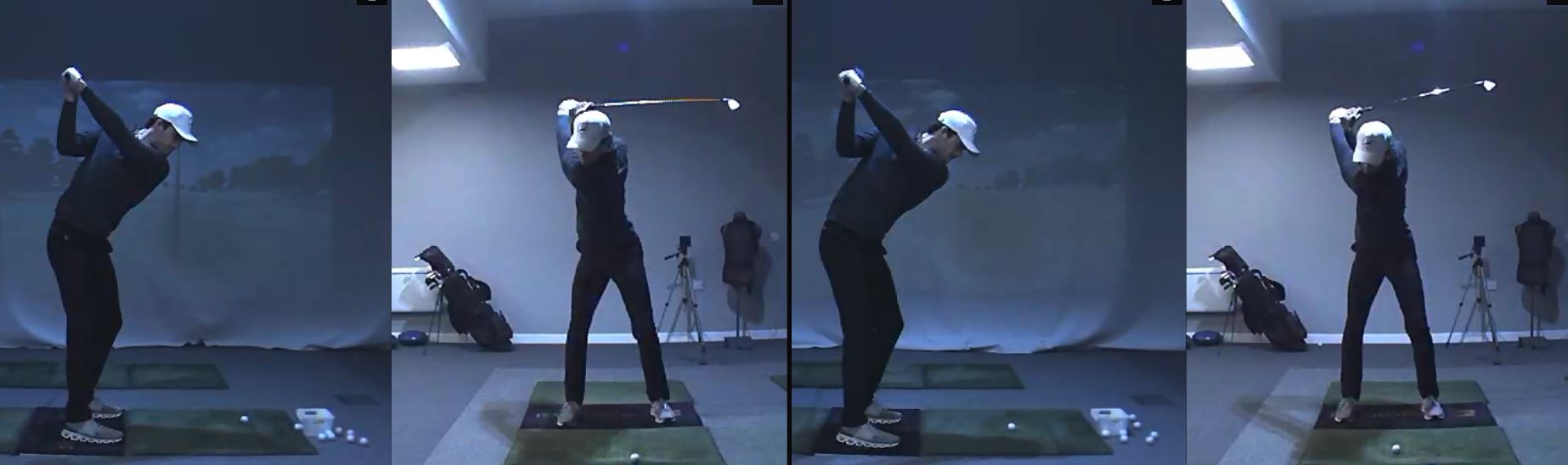
Peripheral vision does not measure. It orients. It allows the body to sense space, timing, and motion without collapse into control. When the ball is held in peripheral awareness, the brain no longer frames the task as “hit this point.” It frames it as “move through space.” The body responds by organising itself globally rather than locally.
Why staring compresses transition time
This has a profound effect on transition. When the eyes fixate, the brain anticipates impact. It pulls the downswing early. The top of the swing becomes a place of danger rather than loading. The transition shrinks. When the eyes soften, the mind is no longer rushing toward a point. It can remain in motion. The player can sense the length of the pause. The transition regains its natural duration.
The difference is not philosophical. It is temporal. The swing stops being a race to impact and becomes a continuous arc through time. Rushing is not impatience. It is perception under threat. Peripheral vision reduces threat. And when threat reduces, time returns.
Why “keep the head still” creates compensations
The instruction to “keep the head still” is the physical extension of the same myth. It attempts to stabilise the eyes by immobilising the body. The problem is that the driver swing is not a small movement. It is a full rotational act in which the thorax, pelvis, and arms must travel through space at speed. Asking the head to remain static while everything beneath it rotates is not control. It is conflict.
The body responds by creating workarounds. The golfer learns to lift the arms rather than turn the chest. The shoulders become steep. The club is thrown outward. The face must be rescued late. What is then labelled as “over the top,” “early extension,” or “casting” is often nothing more than a body trying to swing around an immovable visual anchor.
When the head is allowed to rotate and tilt naturally, the system rebalances. The eyes are no longer fighting the body. The neck is no longer acting as a governor. The thorax can rotate under the head rather than around it. The swing becomes spatial rather than guarded.
How peripheral vision changes club delivery
This has a direct effect on club delivery. A player who fixates tends to approach the ball as a target to be struck. The club is driven at a point. The path becomes corrective. The hands manipulate. The face is steered. A player who operates in peripheral awareness moves the club through space. The ball is encountered, not hunted. The path stabilises. The face arrives, rather than being forced.
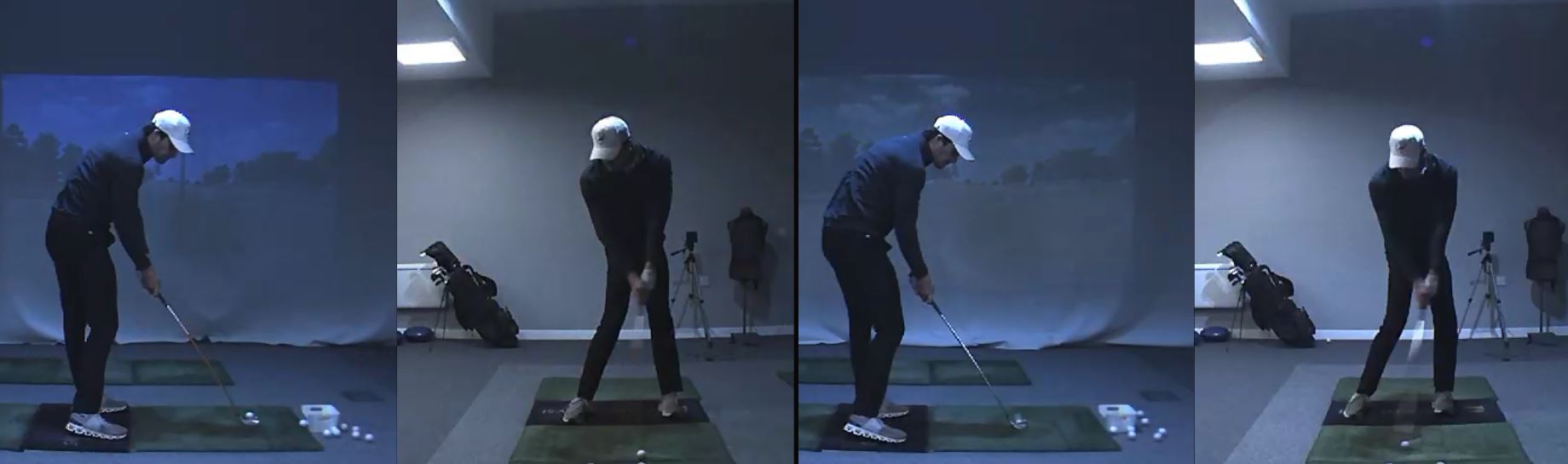
Strike quality improves not because the player tries harder, but because the system is no longer fragmented. This is why so many golfers experience sudden clarity when they stop staring. They often report: “I felt as though the swing happened around me.” “I wasn’t thinking about hitting.” “I had time at the top.” “It felt wider.” “It felt slower, but the ball went further.” These are not metaphors. They are descriptions of a nervous system that has exited protection. Fixation creates urgency. Peripheral vision restores continuity.
The driver is the club most sensitive to this shift because it magnifies time. The longer arc and higher speed make the cost of rushing obvious. The moment the transition collapses, the sequence fractures. Golfers then attempt to fix this mechanically. They rehearse pauses. They count. They exaggerate tempo. They practise drills. But the body cannot hold time while the eyes are signalling danger.
The solution is not to control the transition. It is to remove the cause of its collapse. That cause is visual threat. When the eyes are permitted to soften, the brain no longer treats the top of the swing as a place of risk. The golfer does not need to “wait.” He simply continues moving. The length of the transition is no longer imposed. It is allowed.
This is why this change often feels as though it fixes multiple faults at once. Players report better rotation, shallower delivery, more centred strike, more speed, less tension, improved rhythm. No mechanical instruction has been given. Only a perceptual one. The swing reorganises because the body is no longer defending itself against the task.
This is not about looking away dramatically or ignoring the ball. It is about changing the relationship. The ball should exist in awareness, not domination. A golfer does not need to see impact in order to strike well. The brain is exceptionally good at timing when it is not interfered with. What it struggles with is being forced to coordinate under threat.
Soft eyes. Natural head tilt. Peripheral awareness. These are not techniques. They are permissions. They allow the body to do what it already knows how to do. The driver swing is not a hit. It is a motion through space. When the eyes stop guarding a point, the body can finally move.
FAQ
Should I keep my eye on the ball when driving?
You should remain aware of the ball, but rigid fixation often narrows perception and increases protective tension. For many golfers, softening the eyes and letting the ball sit in peripheral awareness reduces threat and improves the organisation of rotation and timing.
What does “2 o’clock vision” mean?
It describes a relationship where the ball is not directly stared at as the central point of attention. With a subtle head tilt and slight head rotation, the ball sits slightly off the main line of sight, which supports peripheral awareness while still keeping the ball clearly present in the visual field.
How does this stop me rushing from the top?
Fixation increases impact anticipation, which often compresses transition time. Peripheral awareness reduces perceived threat, which allows the nervous system to tolerate a longer, smoother transition. The goal is not to force a pause, but to remove the urgency that collapses it.
Will looking away reduce strike quality?
Not if you remain aware of the ball. The aim is not to lose the ball visually, but to stop treating it as a fragile target that must be guarded. Many golfers see improved strike because the body stops stiffening and the club can reorganise in space without last-moment steering.