Bad shots stop spreading
You read a poor shot as information, not a verdict on your ability, so it doesn’t follow you to the next tee.
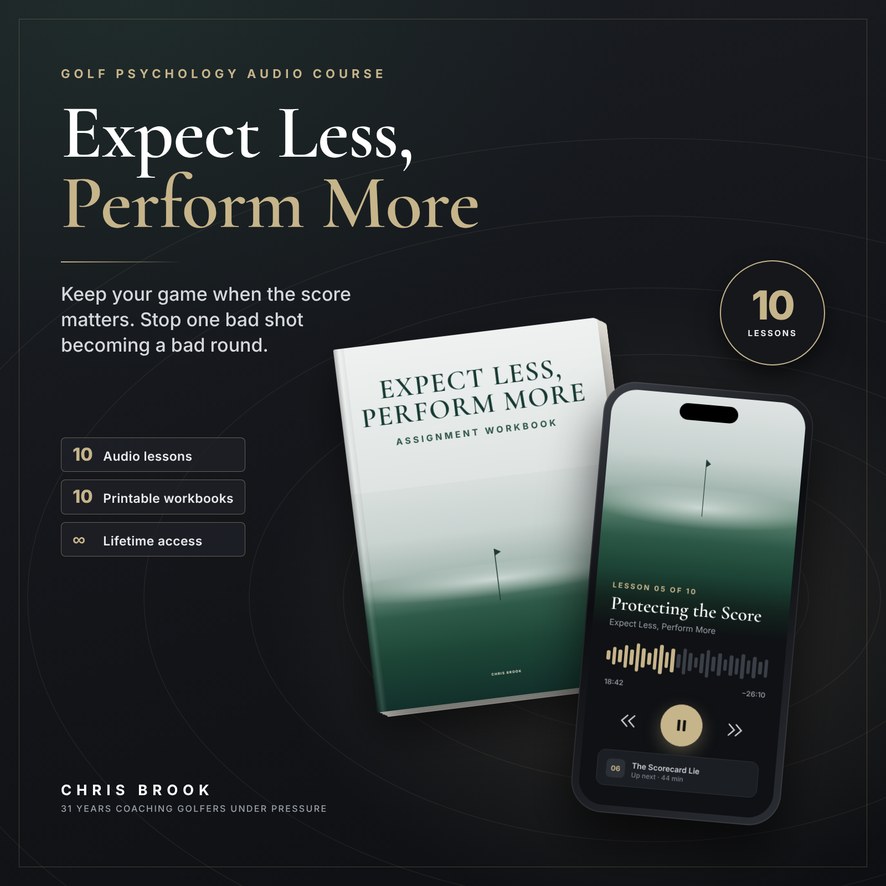
Golf Psychology Audio Course
Free on the range. Careful when the card is live. One bad shot, and the round starts slipping away.
Expect Less, Perform More is the ten-lesson audio course in which Chris Brook teaches the pressure framework he uses with tour professionals, national and county players. Learn why your game changes when the score matters, stop one mistake from becoming a run of dropped shots, and take more of your practice golf onto the course.
The Problem
When the score starts to matter, your attention narrows, tension creeps into the swing and your decisions turn careful. It isn’t a technique problem, and trying harder usually makes it worse.
Why Familiar Advice Fails
Trust the swing. Forget the last shot. Stay in the moment. It’s good advice, but it describes where you want to be, not how to get there when the score feels like a threat.
Expect Less, Perform More shows you what pressure is actually changing in your attention, your body and your decisions. Once you can see it, you can catch it early and respond, instead of hoping the feeling goes away or letting it decide the next shot for you.
No slogans. A clear framework you can use on the course, one shot at a time.
Free Sample
Listen to a short excerpt and judge the teaching for yourself. If it describes your golf, the full course goes much further.
Prefer to read? Try the introduction and the first three assignments from the workbook.
What Changes on the Course
You learn to spot what’s happening early, while one moment is still just one moment, and keep it from taking over the rest of the round.
You read a poor shot as information, not a verdict on your ability, so it doesn’t follow you to the next tee.
You recognise what pressure is doing to your attention and tension, and know what to do next instead of assuming your game has gone.
You spot the reactions that turn one mistake into a run of dropped shots, and stop them early.
You stop asking the previous shot to decide whether the next one deserves full commitment.
You stop protecting a strong start and keep playing the way that built it.
You train with consequence built in, so your range game stops disappearing on the first tee.
The Ten Modules
Ten lessons in a deliberate order, each tackling one part of the pressure pattern. Take one a week and you’ll have the complete framework within a season.
How internal demands begin creating pressure before the round has revealed anything.
Why the range and golf course ask different questions of attention, movement and trust.
How perception, physiology, decision-making and muscular organisation can change.
Why relinquishing control after commitment is not the same as becoming passive.
Why a strong start can make the golfer abandon the behaviour that created it.
Why the number records outcomes but cannot explain the entire performance.
Why adaptability is more useful than demanding identical golf every time.
How self-evaluation makes confidence unstable and performance threatening.
How to recognise reactions before one moment becomes the rest of the round.
How to carry the complete framework into preparation, competition and reflection.
What You Receive
Listen on the drive to the club, use the workbook after your round, and test it in your next competition.
About 45 minutes each. Download once and listen anywhere, even offline.
Short printable exercises after each lesson that turn the ideas into changes you can see in your own rounds.
Come back to any lesson before a big event, or whenever an old pattern returns.
Example Assignment
One workbook asks you to document the sequence that follows a mistake rather than judging only the shot itself. You examine:
This is how the course turns listening into change: you learn to catch the pattern while it’s still small enough to stop.
A Clear Fit
Created by Chris Brook
Chris Brook has coached golf for 31 years, working with tour professionals, national and county players and serious amateurs. He specialises in golf biomechanics and performance psychology, and is the author of Quiet the Mind, Lower the Score.
This course is the structured version of the work Chris does one-to-one with players whose game changes when it counts: the same framework, for a fraction of the cost of individual coaching.
The Investment
Most golfers spend far more on new equipment and swing changes, yet nobody shows them why the game they already have disappears when the result matters. This course does.
For £59 you get ten audio lessons, ten workbooks and lifetime access: less than a single one-to-one hour with Chris, and something you can return to every season.
You’re not buying ten recordings. You’re learning how to keep your game when it counts.
No. The course works as a standalone programme. Quiet the Mind, Lower the Score provides the wider published framework, but it is not a prerequisite.
Your purchase provides a downloadable package containing ten audio modules and ten printable assignment workbooks. You can work through them at your own pace and revisit them later.
There is no need to rush. The work is most useful when each module is given time to influence your observation during practice and play before moving immediately to the next.
No. It is for serious golfers and coaches at different levels who recognise that pressure, expectation and emotional reaction change performance.
No. The course addresses performance psychology rather than diagnosing your swing. Technical and psychological problems can interact, but they still need to be distinguished accurately.
Yes. Listen to the free sample lesson on this page to hear the teaching style and depth first. Because the course is a digital download, it is non-refundable once access has been provided, so the sample is there to help you decide.
If the framework needs applying directly to your own patterns, golf psychology coaching provides one-to-one assessment and guidance.
Begin the Course
Learn why your game changes when the round matters, and take more of your practice golf onto the course.
£59
One-off payment. Ten audio lessons, ten workbooks, lifetime access.
See every book and course, plus the upcoming podcast and webinars, on the Learn page.