Part of the Chris Brook Golf Biomechanics Series — in-depth technical studies exploring how movement, perception, and identity interact to shape performance.
Introduction — Why “Clearing the Hips” Has Been Misunderstood
For decades, golf instruction has used the phrase “clear the hips” to describe the athletic motion that unlocks power in the downswing. The words sound simple, yet they shape a false picture. “Clear” is often taken to mean “twist the pelvis faster.” The reality, shown in 3D motion capture and force-plate data, is different. The pelvis does not clear by choice. It clears by force.
Every visible rotation of the pelvis is the product of invisible torque that is driven from the ground up. The golfer never turns the hips in isolation. The system responds to pressure changes, joint alignments, and timing windows. When this orchestration is correct, the pelvis accelerates naturally. When it is misunderstood, the body fights itself and rotation stalls.
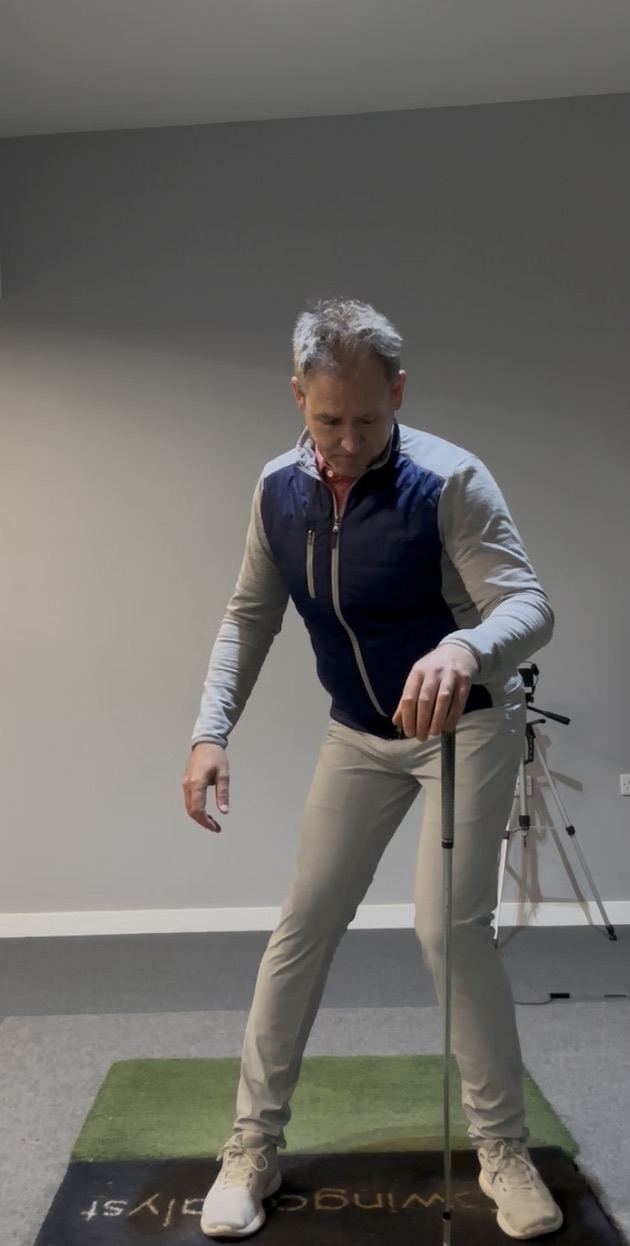
Clearing the pelvis is not a command. It is a consequence. It begins when the lead leg interacts with the ground in a very specific way. There is a brief flexion and inward rotation that prepares the body to push. This preparation unweights the system, sets joint geometry for torque creation, and positions the pelvis for dynamic rotation. In biomechanical terms, the pelvis clears because of ground-reaction torque, not because of a voluntary twist.
Golfers who try to actively spin the hips usually interrupt this sequence. They override the natural timing between flexion, extension, and torque production. They replace organic acceleration with muscular effort. This article explains, in both scientific and practical language, how the pelvis truly clears, why flexion is preparation rather than load, and how to train the pattern so that it holds under pressure.
The Physics of Torque and Ground Reaction Forces
Torque, represented by τ, is produced when a force is applied at a distance from an axis of rotation. In simple terms, τ equals r times F. In a golf swing, torque is created not by pulling or twisting the pelvis, but by pressing into the ground at an angle that produces a rotational reaction about the body.
During the downswing, both feet engage the ground asymmetrically. The trail foot produces backward and medial shear. The lead foot produces forward and lateral shear. These opposing vectors and their separation create a rotational couple that turns the pelvis. The distance between the vectors is the moment arm. The greater the useful separation and directionality, the more effective the torque.
High quality 3D force-plate systems, such as SwingCatalyst and TrackMan with force-vector integration, show a consistent pattern. The lead vertical ground-reaction force rises rapidly as the lead leg extends. Horizontal shear and torsional components build through the transition, then peak as the pelvis accelerates. The vertical force tends to peak just before impact. The rotational spike occurs earlier as the leg moves from flexion to extension.
The torque graph tells a simple story. The dip in the curve corresponds to lead-knee flexion, where the system unweights. The following spike occurs as the lead leg extends and externally rotates. That is the true loading event. It is not downward pressure that builds rotational power. It is upward force applied through precise joint alignment and timing. When the golfer pushes up and slightly around through the lead side, the ground provides an equal and opposite rotational reaction. The pelvis turns because the ground pushes back.
The Lead Leg — Unlocking, Aligning, and Driving Torque
The lead leg is both conductor and transmission. It positions the limb so that forces from the ground can travel upward with minimal leakage. The sequence begins with a small, intentional flexion of the lead knee during the transition. This flexion is coupled to internal rotation at the tibia and femur, and controlled pronation at the foot. Collectively, these actions unlock the kinetic chain.
The Screw-Home Mechanism and Why Inward Rotation Matters
The knee behaves like a corkscrew hinge. Near full extension, it locks through external rotation of the tibia relative to the femur. To flex, the tibia must internally rotate. This is the unlock. During transition, a small inward rotation of the lead knee allows flexion, stores elastic energy, and positions the axes of the ankle, knee, and hip so that the subsequent push can create both vertical and rotational force. Without this unlock, the leg remains rigid, and the push becomes vertical only. The pelvis then lifts without clearing.
Flexion as Preparation, Not Load
It is easy to mistake flexion for loading because the body lowers. In force data, however, vertical ground reaction drops slightly during this phase. The system is preparing to push. The centre of pressure typically shifts medially toward the inner forefoot and inner heel. The foot is more compliant during pronation, which allows acceptance of load and a controlled move of the centre of pressure. The femur internally rotates and adducts slightly. The posterior chain lengthens under tension. The hip capsule positions for a clean path into extension.
- Ankle: dorsiflexion with controlled pronation.
- Knee: flexion with internal tibial rotation.
- Femur: internal rotation with slight adduction.
- Pelvis: small internal rotation and anterior tilt on the lead side.
- Effect: unweighting, elastic pre-tension, centre-of-pressure set for torque.
Transition into Extension
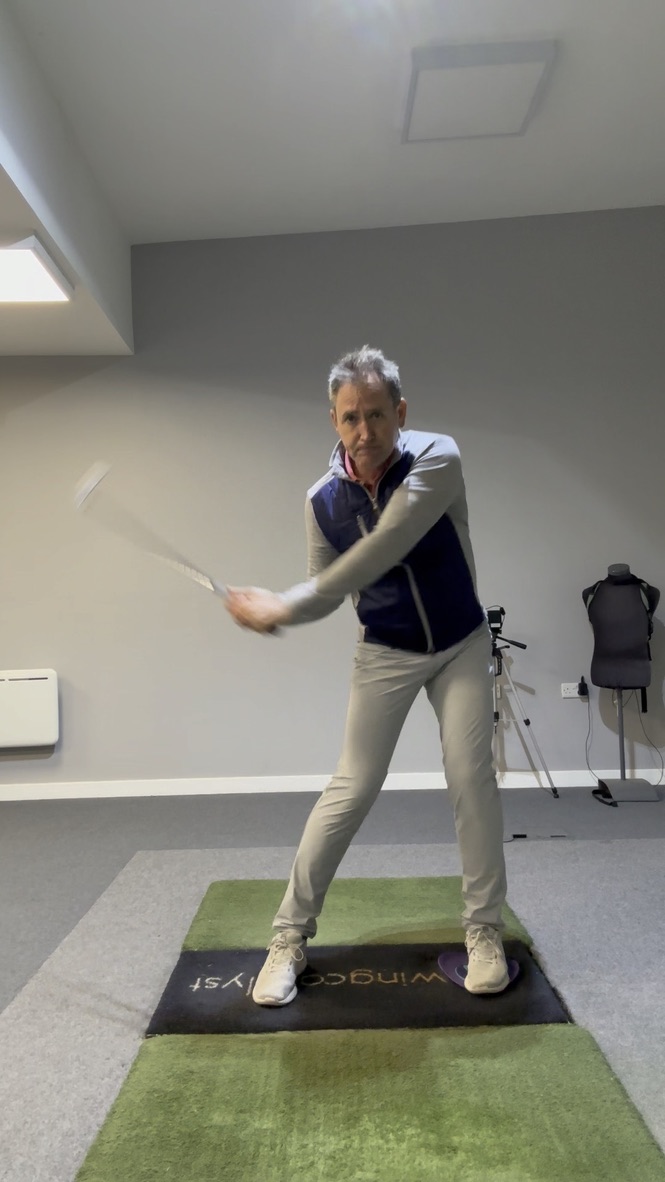
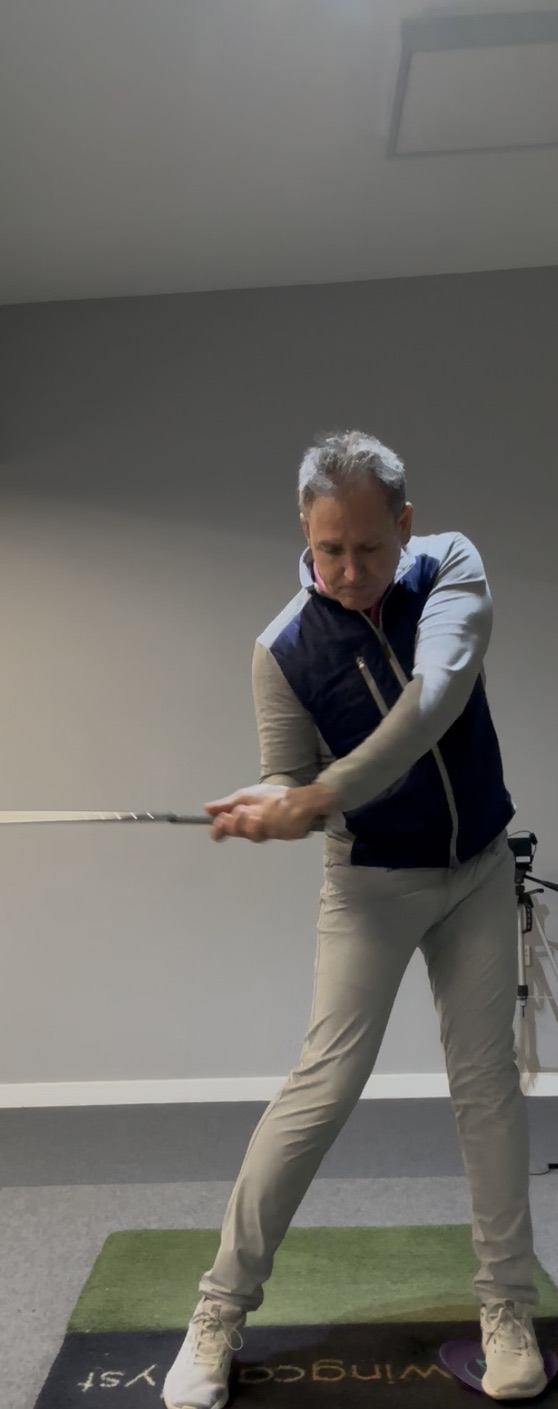
As the hands lower and the club shallows, the golfer begins to push. The tibia externally rotates. The femur externally rotates and moves toward abduction. The foot transitions from pronation to supination. The windlass mechanism tensions the plantar fascia. The foot shifts from a mobile adapter to a rigid lever. The vector of the push is not purely vertical—it is diagonally up and slightly around through the hip socket. That diagonal component is what creates rotational torque measured in N·m.
Gluteus maximus, especially superior fibres, and adductor magnus contribute to extension and external rotation. The pelvis begins to accelerate open. The lead ilium rotates posteriorly and externally. The trail ilium rotates anteriorly and internally. The sacrum allows a few degrees of nutation and counter-nutation that help transmit torque through the spine.
- Ankle: rising plantar-flexion bias with supination.
- Knee: moving toward extension with external tibial rotation.
- Femur: external rotation and slight abduction.
- Pelvis: accelerates into external rotation and posterior rotation of the lead ilium.
- Effect: vertical-force spike, rotational shear, torque production, pelvic clearance.
What the Golfer Should Feel — The Applied Version
To the golfer, this is less about turning and more about pushing. Think of pressing the ground away under the lead foot, not only downward but slightly around, as if twisting the turf under your shoe. The pelvis does not need a command to spin—it will rotate because torque has been created below it.
Golfers often confuse lowering with loading. You can lower without ever producing useful torque. Real loading occurs when the leg pushes up and around. That upward and outward drive frees the pelvis to rotate.
The gliding-disc drill makes the pattern obvious. With a disc beneath the lead foot, flexion allows a slight glide inward. That is the unweighting. Then you press and twist. The disc resists and bites. That bite is the feel of torque being created. The pelvis begins to open as a reaction, not as an instruction.
The Exact Role of Inward Lead-Knee Rotation
This is the precise, joint-level explanation of how the lead knee rotates inward to position the limb for torque.
Foot and Ankle
Subtalar pronation with mild dorsiflexion during the brief unweighting. Purpose: accept pressure and let the centre of pressure migrate medially and forward. This sets a moment arm for rotational shear when you later push. Maintain the tripod—heel, first and fifth metatarsal—so the arch does not collapse.
Tibia
Internal rotation during flexion unlocks the screw-home mechanism, allowing the knee to flex freely, store elastic energy, and align the shank so that the ground-reaction vector can create rotational shear in the drive.
Femur and Hip
Internal rotation with slight adduction during flexion pre-tensions the posterior-lateral hip system and adductor magnus. It positions the femoral head so that extension with external rotation can drive torque without impingement.
Pelvis Response
Slight internal rotation and anterior tilt on the lead side create pelvic obliquity and store elastic energy in the posterior oblique sling linking trail latissimus dorsi through the thoracolumbar fascia to the lead glute.
Safe Alignment Guidelines
- Kneecap tracks roughly over the second or third toe—inside neutral but not valgus collapse.
- Allow controlled pronation in the unweighting phase, then feel the arch reform as the foot supinates in the drive.
- Lead-foot flare of ten to twenty degrees reduces hip impingement and lets the knee track cleanly.
Common Errors and Quick Fixes
- Valgus collapse: knee dives inside big toe; arch dumped → fix by re-establishing tripod.
- Staying in flexion too long: pelvis stalls → begin extension by lead-arm-parallel.
- Spinning pelvis from torso: no useful ground reaction → cue the push up and around under lead foot.
Pelvic Function — The Micro-Phases of Torque Transmission
3D motion capture consistently shows a multi-phase pelvic pattern through transition and downswing. Each phase has a role.
Phase 1 — Pre-Torque Preparation
Lead knee flexes and rotates inward. Lead acetabulum drops and moves slightly forward. Pelvis tilts toward the target and rotates subtly internally. Trail side remains higher. Posterior oblique sling tensions. The sacrum begins to torsion within the sacro-iliac joints. This is elastic pre-load, not active turning.
Phase 2 — Force Transition
As the golfer pushes through the lead foot, the pelvis responds. Lead ilium rotates posteriorly and externally; trail ilium rotates anteriorly and internally. Pelvic torsion develops. Lead vertical ground-reaction force increases and the horizontal component turns into a direction that supports rotation. The pelvis converts vertical work into rotational acceleration.
Phase 3 — Torque Amplification
As the lead arm approaches parallel, the pelvis often reaches peak angular velocity. Lead hip extends and externally rotates; trail hip continues to internally rotate. The sacrum briefly nutates, aligning the spine over a stable base. Torque peaks in this phase, measured in N·m. Lead side begins to function as a rotational brake while the trail side continues to drive.
Phase 4 — Braking and Transfer
After peak velocity, the lead gluteus medius and adductors control deceleration. This braking transfers energy upward—from pelvis to thorax, then to arms and club. Without controlled braking, rotation would spin out or lose posture. Elite players decelerate the pelvis precisely so the segments above can accelerate in sequence.
Phase 5 — Post-Impact Stabilisation
After impact, both hips extend. The pelvis continues to rotate at a decelerating rate and then re-centres beneath the torso. The sacro-iliac joints return toward neutral. Balance is restored and kinetic energy dissipates safely.
Force-Vector Geometry — How the Ground Creates Clearance
The direction of the ground-reaction vector is as important as its magnitude. In efficient swings, the lead foot’s force vector is angled diagonally—often twenty-five to thirty-five degrees backward and outward relative to the target line. That angle produces both lift and rotation.
If the vector is too vertical, the pelvis lifts without clearing. If it is too lateral, the player slides and rotation is limited. When the vector is diagonally up and around, the pelvis is rotated by physics. The hips open, the club shallows naturally, and the sequence holds.
The Gliding Disc Drill — Translating Physics into Feel
Place a gliding disc under the lead foot. Take your normal backswing.
- Flexion phase: soften the lead knee and allow a small, controlled inward glide. That is the unweighting.
- Extension phase: press down and twist the disc. Feel it grip. That grip is the reaction force that produces torque.
- Rotation response: let the pelvis open as a consequence of the push. Do not try to spin it.
The drill exaggerates the transition between soft acceptance and firm drive. It teaches timing and direction without over-coaching positions. Use slow motion first, then blend into half swings. Film face-on to confirm that the flex–extend cycle and pelvic acceleration match the pattern described above.
The Jar-Lid Analogy — Why It Works for Biomechanics and the Brain
Before you twist the lid, you often make a tiny counter movement. Then you set your palm, press, and twist. In the downswing, the inward knee and flexion are your counter movement. Setting the foot and pressing are your preparation and load. The twist is the rotational reaction you receive from the ground. The pelvis opens because the ground turns you.
The analogy also works at the neurological level. The brain understands the jar action as a complete pattern. It reduces conscious interference and engages a global motor programme. You guide intention, and the body self-organises around accurate physics.
Neurological Sequencing and Motor Imagery
Motor imagery recruits a significant portion of the neural circuits used in actual movement. When a golfer holds the jar image in mind, the motor cortex and cerebellum are primed. Balance systems in the inner ear, proprioceptors in the joints, and the fascial slings that transmit force all integrate more cleanly because the intention is singular. The message to the system is coherent: push, twist, release.
Quiet the Mind, Lower the Score expands on this mechanism. The goal is not to think less, but to direct attention toward a physical intention the nervous system can translate into a full-body pattern. The mind quiets not through suppression, but through specificity of intention.
Physiology — How the Body Interprets Torque
Ground-reaction forces do not travel through a static frame. They move through a living system that senses and adapts.
- Vestibular system: detects acceleration and head orientation, maintaining equilibrium as the pelvis rotates.
- Proprioceptors: sense changes in muscle length and joint tension, feeding the cerebellum continuous data for coordination.
- Fascial lines: transmit load and recoil across distant segments, particularly the posterior oblique and spiral lines critical in rotational sport.
When the sequence is correct, sensory inputs agree. The movement feels powerful yet effortless. When mistimed, sensory signals conflict; the system protects itself through stiffness and over-control. The difference between free rotation and struggle is not strength—it is synchrony.
Psychology — Perception, Control, and Trust
Most breakdowns in pelvic clearance begin in perception, not in muscle. Under pressure, golfers try to control the outcome by commanding positions or spinning the hips. That act of control threatens the system’s natural timing. The prefrontal cortex overrides the automatic coordination that would otherwise flow. The more the player tries to twist, the less the pelvis clears.
The solution is to redirect intention toward the correct cause. Focus on the push under the lead foot. Attend to the timing of the press and the moment the disc or turf grips. Allow rotation rather than commanding it. Trust is not belief; it is the neurological condition in which the brain stops micromanaging and lets learned timing run.
Integration — The Clarity Method
The Clarity Method integrates biomechanics, psychology, and performance identity:
- Biomechanics provides structure — how torque is created and transmitted.
- Psychology provides perception — how attention and emotion interact with movement.
- Identity provides stability — who the golfer believes they are under pressure.
Identity determines whether the pattern holds when it matters. If you view yourself as someone who moves with clarity, your system organises around clear physics. If you view yourself as someone who must remember mechanical cues, you revert to control when stress rises. One approach stabilises. The other fragments.
Closing Summary — Physics, Physiology, and Freedom
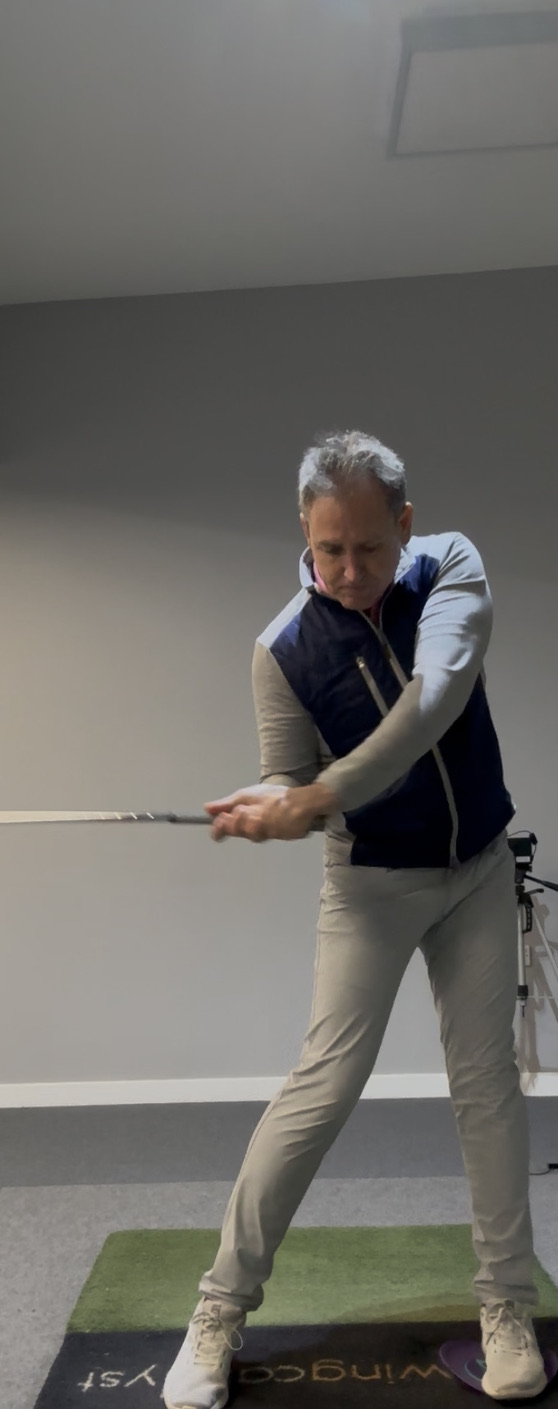
To clear the pelvis is to let the ground rotate you. Flexion unweights and aligns. Extension loads and releases. Internal rotation prepares. External rotation delivers. The ground provides torque; the nervous system coordinates it; trust connects them.
When biomechanics, psychology, and identity align, the pelvis clears as a natural consequence of correct force direction. This is not the absence of technique—it is technique realised. True control comes from clarity, not effort.
FAQ
Is lead-knee flexion the same as loading?
No. Flexion prepares the system; it does not load it. During flexion, vertical ground-reaction force drops slightly. The true load occurs in extension, when the leg pushes up and around through the lead hip, generating both vertical and rotational torque.
What lead-foot flare angle is ideal for rotation?
A lead-foot flare of ten to twenty degrees suits most golfers. It allows internal rotation in the knee and hip during flexion without impingement, while still giving a stable base for external rotation and torque generation during extension.