Quiet the Mind, Lower the Score | Golf Psychology Book by Chris Brook
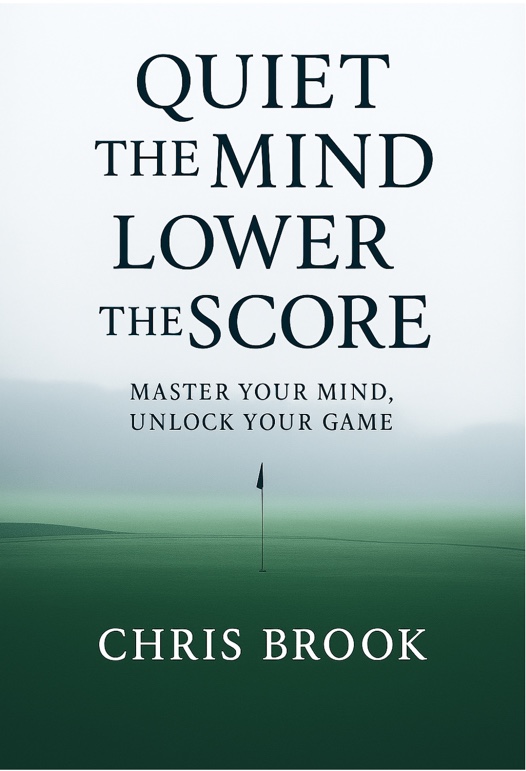
Quiet the Mind, Lower the Score book cover by Chris Brook
A Legacy Work in Golf Psychology

Quiet the Mind, Lower the Score

A golf psychology book built from 30 years of experience and written over 10 years. A serious study of pressure, confidence, perception, identity, emotional control, and what really changes when golf becomes difficult to trust.

This book was not written quickly. It grew slowly through decades of coaching, observing, competing, and trying to understand why golfers can possess skill and still lose access to it when pressure rises. It is the clearest expression of the work Chris Brook has been developing across his coaching, articles, and teaching.

Quiet the Mind, Lower the Score is for golfers who have realised that technique alone does not explain what happens on the course. The swing may be present, yet something changes when consequence appears. Tempo shifts. Awareness narrows. Thoughts become louder. The player becomes more self-conscious, more careful, and less free. The book examines those changes carefully.

Across 25 chapters and 283 pages, it offers a framework for understanding state, confidence, emotional control, perception, transfer, performance identity, adversity, and long-term mental training. It does not rely on slogans, hype, or borrowed motivation. It tries to describe the golfer’s experience accurately and then make that experience more understandable.

25 Chapters 283 Pages Written Over 10 Years Built from 30 Years of Experience
What the Book Addresses

When the Game Changes Under Pressure

A golfer may practise well and still struggle when the round matters. The motion is there, yet performance becomes unstable. A bad hole seems to linger. Confidence starts to feel unreliable. Attempts to control the swing create more tension rather than less. What should feel familiar begins to feel fragile.

Many golfers interpret that experience too simply. They assume they are weak, mentally poor, or technically unsound. This book argues that the problem is more complex. Pressure alters awareness. Expectation distorts behaviour. Emotional state affects timing and decision making. Identity changes the meaning of every shot.

This is the starting point of the work. Not inspiration. Not urgency. A more accurate explanation of what many golfers actually live through.

The Structure of the Book

A Complete Framework, Not a Collection of Tips

Part I: State, Confidence, and Emotional Control

The opening section examines the golfer without an inner anchor, the relationship between mind and mechanics, the brain’s role in golf, personality under pressure, state, confidence, and the emotional game inside the game.

Part II: Growth, Transfer, and Swing Change

The middle of the book addresses perception, mindful practice, resistance to change, transfer from range to course, time frames, and how swing change becomes durable rather than temporary.

Part III: Performance, Adversity, and Mastery

The later chapters move into tournament preparation, the space between shots, flow state, letting go, the mental round, nutrition and hydration, the mental scorecard, slumps, success, and long-term mental training.

Quiet the Mind, Lower the Score is not organised around quick fixes. It is organised around understanding the deeper conditions that shape performance, and then training those conditions with more intelligence.
25 main chapters
14 workbook tools
4 major parts
1 integrated philosophy
What You Will Find Inside

The Core Themes of the Work

State and Confidence

The book examines confidence as something more structural than mood. It looks at how energy, emotional control, and the golfer’s immediate state affect access to skill.

Perception and Attention

Several chapters explore how the brain perceives the game, how threat changes awareness, and why the golfer’s experience under pressure is often perceptual before it is technical.

Swing Change and Transfer

The book gives serious attention to why change is hard, why ego resists it, and why players so often fail to transfer range work onto the course.

Performance Identity

A central thread of the book is that the golfer always plays through a self-story. Identity is not peripheral. It affects what the player expects, fears, and believes is happening when performance shifts.

Adversity and Recovery

The work studies tournaments, the space between shots, letting go, slumps, success, and how golfers can move through difficult periods without becoming internally chaotic.

Mental Training as a System

The book closes with structured methods such as the mental scorecard, periodised mental training, and practical workbook tools designed to make the framework usable rather than abstract.

Selected chapter themes
  • the golfer without a master inside
  • golf through the eyes of the brain
  • the power of state
  • confidence: building it, losing it, and rebuilding it
  • the perception trap
  • mindful practice
  • transferring swing changes from range to course
  • the process is the scorecard
  • the space between shots
  • the mental scorecard
  • navigating the slump
  • the mental training cycle
Why the Book Matters

A Book Meant to Stay With the Reader

This is not a seasonal project or a quick-response title. It is a long-form work that took ten years to write and draws on three decades of practical experience. That matters because the book was not built to chase trends in the mental game. It was built to answer questions that tend to remain with golfers for years.

Why does the game become harder to trust when it matters? Why does understanding not always produce change? Why do some players remain calm while others tighten? Why does one bad shot alter the emotional tone of an entire round? Why do some improvements survive pressure while others disappear?

The book does not pretend to solve every golfer in the same way. What it offers is a careful framework for seeing more clearly what is taking place, and why that clarity changes the quality of the player’s relationship with the game.

Expanded Learning

The Quiet the Mind Knowledge Hub

The ideas explored in Quiet the Mind, Lower the Score do not stop with the book. Over time they have expanded through a growing library of articles examining the psychology of golf performance in greater depth.

This expanded learning environment forms the Quiet the Mind Knowledge Hub. It exists as an intellectual companion to the book, exploring themes such as perception, pressure, confidence, emotional control, identity, and the relationship between awareness and performance.

While the book provides the core framework, the hub allows those ideas to continue evolving. Articles examine specific psychological problems golfers encounter on the course and investigate them with greater analytical depth.

Readers who wish to continue exploring these ideas can access the hub below.

The hub also acts as the discovery point for new psychology articles, so returning readers can find the latest additions quickly.

Reader Reviews

What Readers Have Said

These reviews reflect how the book has been received by golfers looking for a deeper understanding of pressure, confidence, and performance.

“The best golf psychology book out there”

Mark Reardon • Paperback • Verified Purchase

This is one of the best golf psychology books available. It’s a good read and it gives you real tools to work on your whole time on and off the course. I’ve read a good number of books on this theme and this is the best by far.

“A Game Changer”

H Denison • Hardcover • Verified Purchase

Perfect for players of all levels. For me, working to break into single figures was just what I needed to quieten those internal battles, to step onto the tee with quiet confidence and calmness.

Well written and easy to read with insightful thought-provoking theories in every chapter.

“How to help yourself become a better golfer”

Mark Edwards • Paperback • Verified Purchase

This is a must read book for anyone working to be a better golfer. Chris brings energy and enthusiasm to the basic disciplines and practices of how to make your game more consistent in an easy to understand way useable by any golfer whatever their current standard.

“Just scored my lowest round.”

Jme • Hardcover • Verified Purchase

Chris is a world class golf coach that has done a great job distilling his knowledge and wisdom into a clear and concise book for the golfer that wants to push their boundaries. I’ve been able to immediately apply his work to my practice sessions and, ultimately, on to the golf course. I just scored my lowest round having applied Chris’s principles. A must read.

“Your Mind Set Fix. All in this book”

Mrs Caroline A Lockyer • Hardcover • Verified Purchase

This truly works. Helps you realise your mind set in different situations we all face out there on the course. Best golf book I’ve read and would genuinely recommend.

“Really enjoyable and informative read”

Steve Telford • Hardcover • Verified Purchase

Contains some great information and strategies to help understand how the mind works under pressure as a golfer and how to develop and focus on what matters to improve. Written through first hand experience at the highest level.

Free Excerpt

Read a Sample Chapter

If you want to see the tone and structure of the book before buying, you can read an excerpt from The Perception Trap. It introduces one of the central ideas in the work: that pressure does not only create emotion, it also changes perception.

Workbook and Application

Built to Be Used, Not Only Read

The book concludes with a dedicated workbook section. These tools extend the framework into practice and reflection, including trigger analysis, state mapping, confidence rebuilding, emotional reset work, feel recovery, mental reps, change timelines, pre-performance structure, the 18-hole mental scorecard, and the nervous system calibration map.

This matters because the book is not simply philosophical. It is also procedural. It tries to help the golfer carry insight into behaviour.

The Wider Work

The Book Within the Chris Brook Framework

The ideas developed in Quiet the Mind, Lower the Score sit at the centre of Chris Brook’s wider work in golf performance psychology. The book is the clearest place to begin. From there, readers can go deeper through the course, related articles, the knowledge hub, or coaching.

About the Author

Chris Brook

Chris Brook is a golf performance coach and author whose work integrates biomechanics, psychology, and performance identity. Across three decades of experience he has tried to understand not only how golfers move, but why performance becomes fragile, why confidence changes, and how psychological state alters access to skill.

Quiet the Mind, Lower the Score is the most complete written expression of that work. It is the book from which the wider ecosystem of courses, articles, coaching, and the expanded learning hub has grown.

Purchase

Begin with the Book

If you would like to explore these ideas in depth, the book is available in paperback, hardback, and Kindle formats.

Available in paperback, hardback, and Kindle.

© Chris Brook

Quiet the Mind, Lower the Score is a long-form golf psychology work built from 30 years of experience and written over 10 years.