The Myth of the Single Swing Plane
The golf swing does not occur on one fixed plane. This article explains, in full biomechanical depth, why the shaft must change orientation during the swing, how delivery plane really works, why dynamic lie matters, how muscular stretch and emotional pressure alter delivery, and how golfers should determine whether their swing plane is actually correct.
Most explanations of golf swing plane reduce the swing to a line drawn through the shaft at address. That is not how a real swing works. Because the golf swing is a three-dimensional rotational movement, the shaft must change orientation through the backswing, transition and delivery. The correct way to judge swing plane is not by appearance alone, but by whether the delivered geometry creates stable club path, stable face-to-path, and stable dynamic lie for the intended shot.
What swing plane actually means
Before discussing whether a plane is steep, shallow, good or bad, the term itself must be defined properly. In geometry, a plane is a flat two-dimensional surface extending infinitely in space. In golf, the word is used more loosely to describe the inclination of the club’s motion relative to the ground.
That distinction is essential. A golfer is not rotating a rigid stick around one fixed axis. The shaft is attached to hands, the hands are attached to arms, the arms are attached to shoulders, and the shoulders are attached to a thorax and pelvis that are rotating in sequence. Because all of these segments move relative to each other, the shaft cannot remain on one permanent plane.
So the practical biomechanical definition of swing plane is this: the inclined route the hands and club travel on as the golfer rotates around posture and delivers the club toward the ball.
Definition
Swing plane is not a static line. It is the moving inclined route created by posture, shoulder orientation, arm elevation, wrist hinge, body rotation and club inertia.
Although the swing plane is often described as a single line, the golf swing does not occur on one fixed plane throughout the motion. The shaft changes orientation between backswing, transition and delivery as the body rotates and the club reorganises around the hands. To understand how the correct delivery plane actually emerges from biomechanics, see the companion article Optimum Biomechanical Swing Plane .
Why the single-plane model fails
The classic single-plane diagram fails because it assumes the shaft should remain aligned with one visual reference from address through delivery. That assumption ignores the basic mechanics of the swing.
During the swing, several things happen that change shaft orientation:
- the arms elevate relative to the torso,
- the wrists hinge,
- the shoulders rotate,
- the clubhead lags behind the hands because of inertia,
- the body changes its rotational relationship to the ground.
The result is that the club moves through a three-dimensional rotational volume rather than tracing a flat sheet of glass.
That is why your backswing traces and downswing traces do not match. The difference is not proof of error. It is proof of movement.
Why setup geometry matters, but does not define delivery
Setup matters because it establishes the initial framework of the swing. At address the golfer creates a relationship between body, hands, shaft, club and ground. Several variables are set:
- distance from the body to the ball,
- hand height relative to the ground,
- shaft inclination relative to the horizon,
- forward bend from the hips,
- shoulder-plane orientation created by posture.
These factors matter because they shape the initial route the club can travel on. But they do not define the final delivery plane. By impact the golfer is no longer in setup geometry. The pelvis and thorax have rotated, the arms have moved relative to the torso, the wrists have retained or released angle, and the clubhead has lagged behind the hands then accelerated through the arc.
So setup is a baseline. Delivery is an outcome.
Important distinction
Address tells you where the system begins. It does not tell you where the shaft must be delivered at impact.
Why the backswing plane is not the delivery plane
One of the most damaging misunderstandings in golf instruction is the idea that the backswing plane should be mirrored by the downswing plane. Your images show why that is false.
During the backswing the shaft often appears to steepen relative to the address reference. That happens because the lead arm elevates, the wrists move into radial deviation, and the torso rotates away from the target. If the golfer tried to keep the shaft locked to the address plane, arm elevation and wrist hinge would be artificially restricted and the backswing would lose functional structure.
So the backswing plane should not be judged by how closely it resembles address. It should be judged by whether it allows the golfer to reorganise the shaft into a functional delivery plane later.
Transition: where the delivery plane is created
The most important reorientation of the shaft occurs during transition. This is the phase where the golfer must reorganise the club from a loaded backswing condition into a delivery route that allows the clubhead to approach the ball with the correct geometry.
Several segmental actions contribute to this:
- the pelvis begins rotating toward the target,
- the lead side begins to stabilise,
- the trail shoulder externally rotates,
- the arms adduct closer to the torso,
- the wrists retain radial deviation while the club falls and rotates.
The result is that the shaft often becomes shallower relative to the backswing plane. That is not because the golfer has “found the line”. It is because the club is being reorganised into a route that supports delivery.
The delivery plane is therefore a dynamic outcome of body mechanics, not a painted stripe in space.
What club path really means
Club path is the direction the clubhead is travelling at the exact moment of impact relative to the target line. It is not the overall direction of the whole swing. It is the local direction of the clubhead at the strike.
Because the clubhead is travelling around the golfer on an arc, its direction at impact is the tangent to that arc. If the delivery arc approaches more from inside the target line, that tangent tends to point right of target for a right-handed golfer. If the delivery arc approaches more across the ball, the tangent tends to point left.
That is why delivery plane matters so much. The delivery plane shapes the arc, and the arc shapes the path.
Mechanical consequence
Change the delivery plane, and you change the direction of the swing arc. Change the swing arc, and you change club path.
What face-to-path really means
Face-to-path is the difference between where the clubface points and where the clubhead is travelling at impact. This relationship largely determines the spin axis of the ball and therefore the curvature of the shot.
If path is +4° and face is +2°, the face is closed relative to the path and the ball tends to curve left for a right-handed golfer. If path is -3° and face is -1°, the face is open relative to the path and the ball tends to curve right.
This is why the correct plane for one shot type may be wrong for another. A delivery plane that naturally produces the correct path for a draw may not produce the correct path for a fade. The plane must support the required face-to-path relationship for the intended shot.
Dynamic lie and face-plane tilt
Dynamic lie is the delivered lie angle of the club at impact. In simple terms, it is the shaft angle relative to the ground at the exact moment the ball is struck.
Dynamic lie matters because it changes the orientation of the face plane relative to the ground. When the face plane tilts left or right, launch direction and spin-axis tilt change with it.
That means dynamic lie is not just a fitting number. It is a movement outcome created by hand height, shaft orientation, body motion and release mechanics.
The myth of toe up equals closed face
Traditional instruction often said that toe up means the face is closed and toe down means the face is open. That description confuses the observed outcome with the actual mechanism.
When the toe rises, the face does not simply rotate closed relative to the shaft. Instead, the entire face plane tilts left relative to the ground for a right-handed golfer. When the toe drops, the face plane tilts right.
This matters because the golfer may blame face rotation when the real cause is dynamic lie and face-plane tilt.
Toe Up
The entire face plane tilts left relative to the ground. The delivered lie is more upright.
Toe Down
The entire face plane tilts right relative to the ground. The delivered lie is flatter.
Steep versus shallow delivery planes
A steep delivery plane means the shaft approaches impact more upright relative to the ground. A shallow delivery plane means it approaches more horizontally.
Steep Plane
- Higher hands
- More upright dynamic lie
- Delivery arc tends to shift left
- Likely tendencies: pulls, pull-fades, over-left misses
Shallow Plane
- Lower hands
- Flatter dynamic lie
- Delivery arc tends to shift right
- Likely tendencies: pushes, push-draws, blocks
Neither plane is automatically correct or incorrect. The deciding question is whether the delivery plane supports the intended path, face-to-path and dynamic-lie relationship for the chosen shot.
Ground reaction force and delivery
Ground reaction force is the force the ground applies back into the golfer when the golfer pushes into it. This matters because downswing motion is not created by the upper body alone. The way the golfer interacts with the ground influences the motion of the pelvis and torso, which then influences the hands and the shaft.
If the lead leg extends more aggressively late in the downswing, the pelvis rises and rotates more. That can elevate the torso and therefore elevate the hands. If the hands rise, the shaft tends to become more upright and dynamic lie tends to become more upright as well.
The movement chain is simple:
- ground reaction force changes pelvis motion,
- pelvis motion changes torso motion,
- torso motion changes hand path,
- hand path changes shaft orientation and dynamic lie.
Release mechanics and delivered geometry
Release refers to how the club rotates relative to the hands and forearms approaching impact. This includes movement from radial deviation toward ulnar deviation, lead-wrist flexion or extension, and forearm pronation and supination.
Release matters because even if two golfers deliver a similar shaft plane, different release behaviours can produce different face presentations and different dynamic lie conditions. That is why impact geometry cannot be reduced to shaft angle alone.
Muscular stretch and why speed destroys plane
The golf swing depends on the body’s ability to store and use elastic energy. During the backswing the hips, trunk and shoulder complex are stretched. That stretch creates the potential for efficient acceleration in the downswing.
If the golfer’s downswing force matches the amount of usable stretch and sequencing available, the body can reorganise the club efficiently. But if the golfer tries to contract harder and earlier than the loaded system can support, excessive muscular tension develops.
Once the muscles have gone beyond their useful stretch capability, the tension itself begins to interfere with the movement solution. The body becomes too rigid to reorganise the club correctly. Instead of the pelvis, thorax, arms and wrists moving in sequence, they begin moving more as a locked unit. The arms lose freedom relative to the torso. The hand path changes. The shaft plane may steepen, reroute or become inconsistent.
Critical implication
A golfer does not always lose plane because they do not know what the plane should be. They often lose plane because muscular tension has removed the body’s ability to produce the correct delivery pattern.
Emotional influence and delivery collapse
Emotional pressure changes swing plane through the body. Under stress many golfers increase grip tension, forearm contraction and upper-body muscular tone. This reduces segmental freedom. The pelvis, thorax, arms and club no longer move with the same sequencing they show in neutral conditions.
The result can be:
- the arms throwing outward earlier,
- the body stopping rotation too soon,
- release timing changing,
- the shaft arriving steeper or more erratic.
The emotional influence does not act on the ball directly. It changes the muscular and segmental conditions that create the delivery plane.
Rory case study
Your Rory sequence is useful because it shows all of these ideas in a real example. At setup the shaft and posture create an initial reference geometry. At the top of the backswing the shaft is on a different orientation because of arm elevation and wrist hinge. Midway down the shaft is reorganised into the delivery plane. At impact the delivered geometry produces a slightly inside path and a face-to-path relationship that creates a controlled draw pattern.
The crucial lesson is not that golfers should copy Rory’s shaft line. The lesson is that an elite player reorganises the shaft into a delivery plane that produces the required impact geometry.
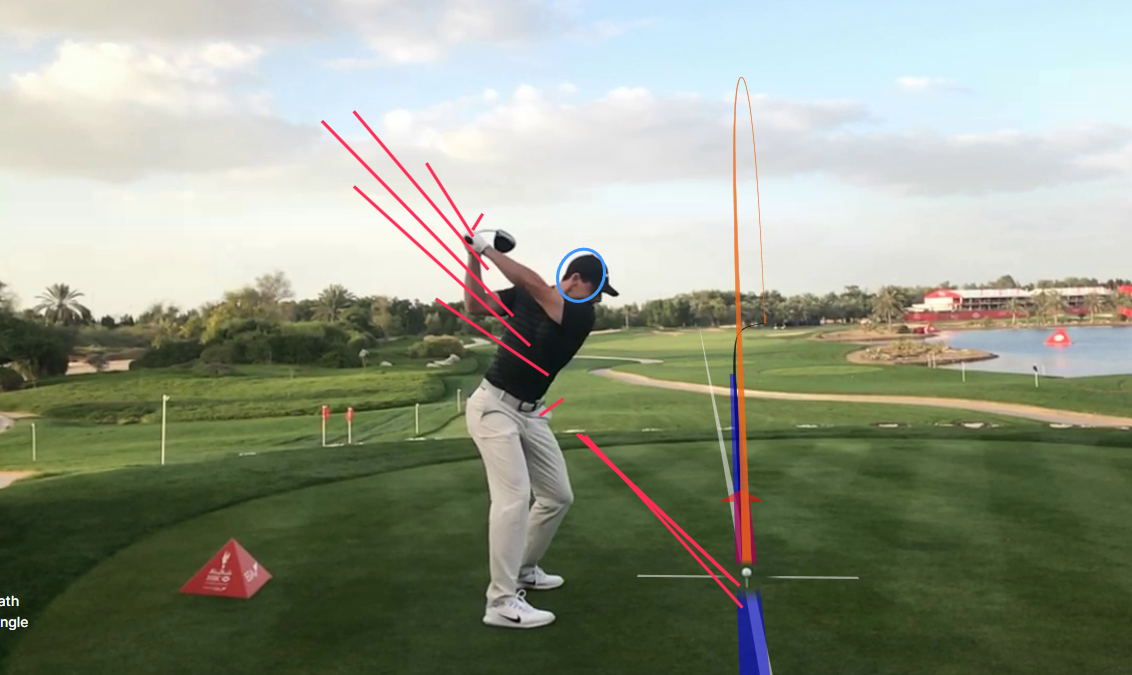 The red shaft plane colour refers to the backswing
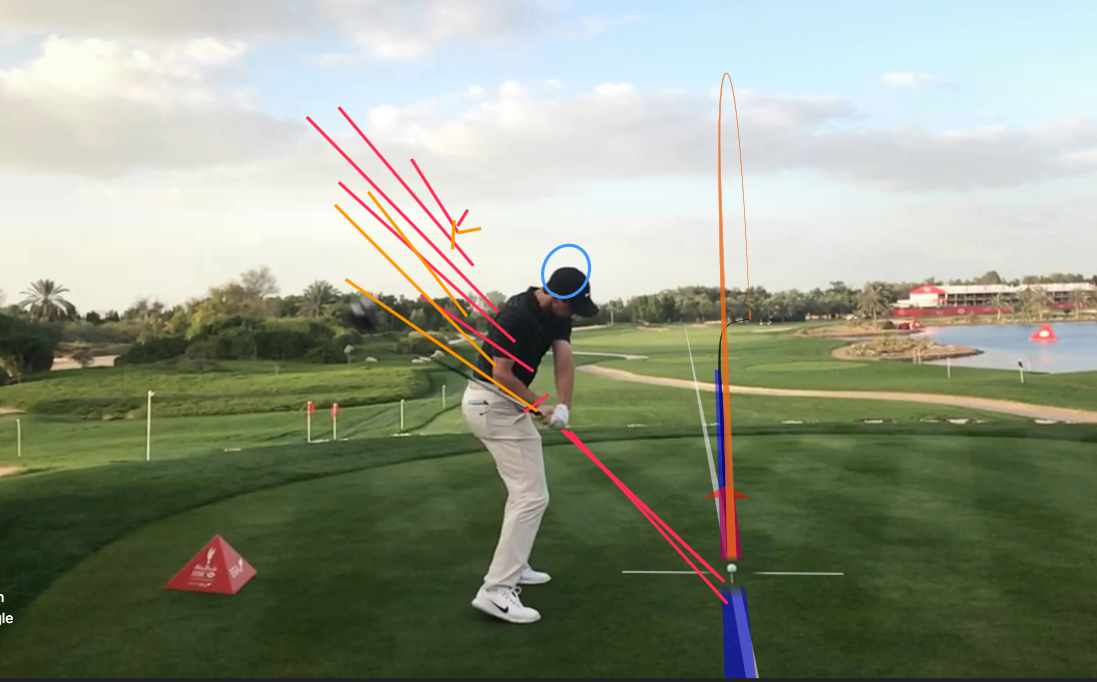
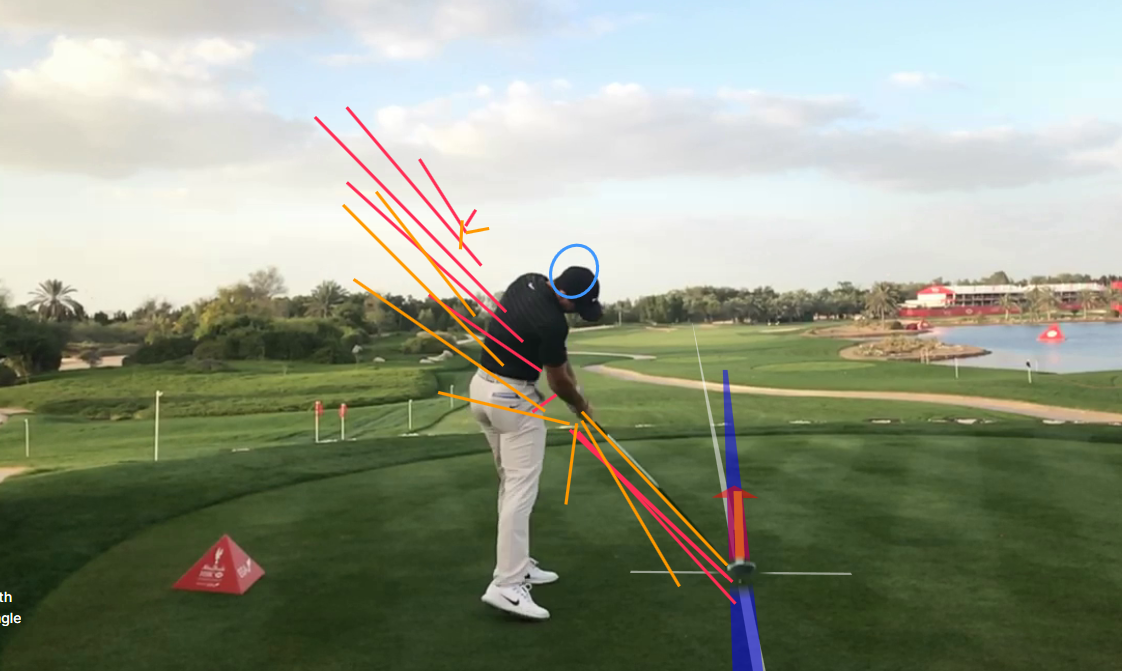
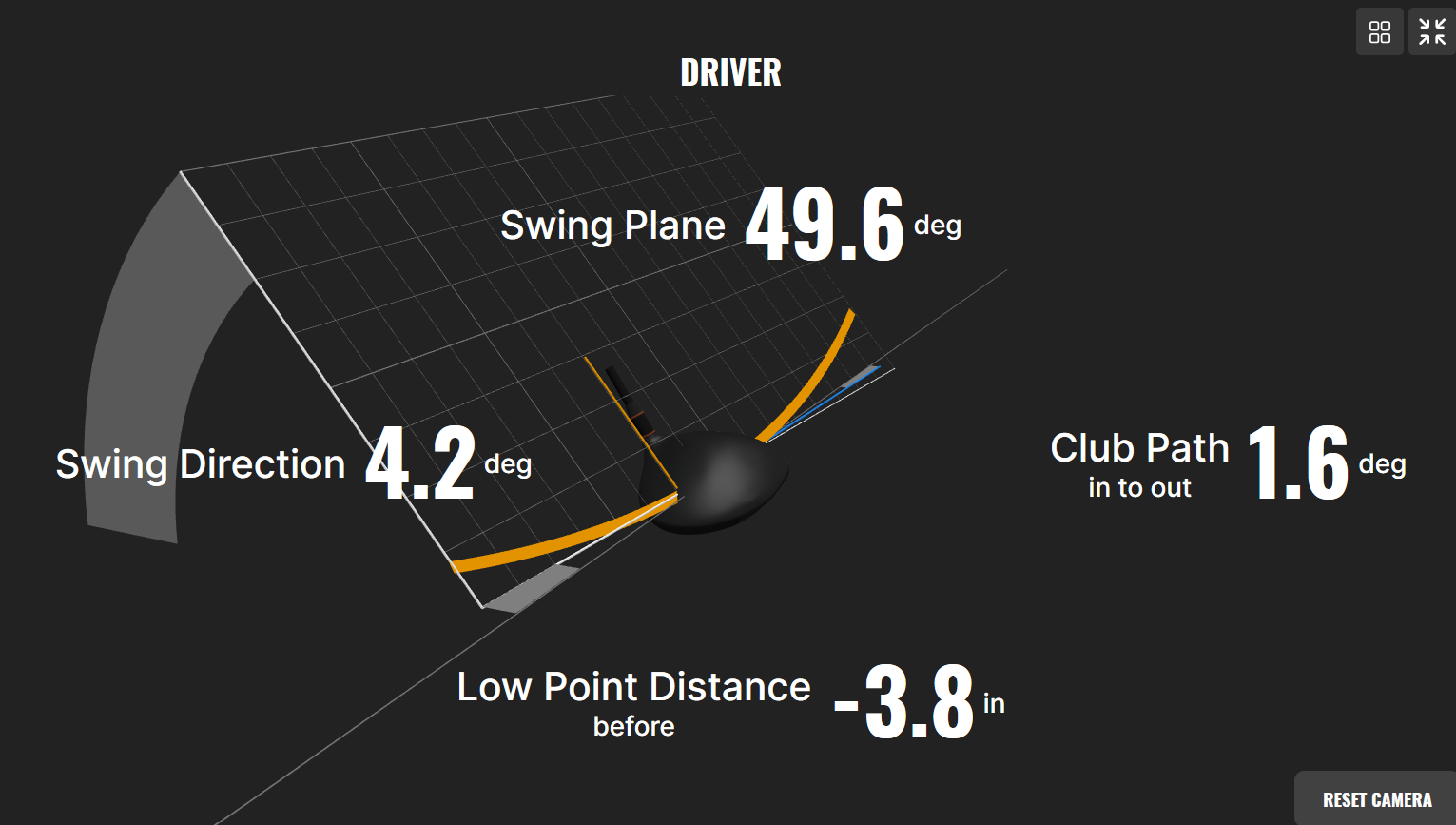 Impact shows the delivered shaft inclination, hand height and dynamic-lie behaviour that matter most.
What makes a plane wrong for the shot type
A swing plane is wrong for the chosen shot when it does not support the required impact geometry. If a golfer wants to hit a draw, the plane must allow the correct rightward path and the correct face-to-path relationship. If the plane instead produces a leftward path, the golfer must manipulate the face or reroute the club late to create the draw anyway.
The same logic applies to a fade. If the delivery plane naturally produces too much inside path for the intended fade, the golfer must throw the club outward or excessively open the face. Both increase timing dependence.
How to know if your plane is correct
The correct plane is not the one that looks most like a model swing. It is the one that repeatedly produces the intended impact conditions.
Three indicators decide this:
- Club path consistency: the intended path appears repeatedly rather than fluctuating wildly.
- Face-to-path stability: the intended curvature can be produced without late rescue.
- Dynamic lie stability: the face plane is not being tilted inconsistently by changing hand height or release.
Practical summary
The golf swing does not occur on a single plane. The shaft changes orientation because the body segments controlling it change orientation. Backswing plane, transition plane and delivery plane are not identical. Different golfers can arrive at impact on different shaft planes and still be correct if they produce stable impact conditions.
The purpose of swing plane is not to satisfy a visual ideal. The purpose of swing plane is to organise the club so the golfer can produce predictable ball flight. That means the correct plane is determined by impact geometry, not appearance. It must support the intended club path, the intended face-to-path relationship and stable dynamic lie. It must also be achievable within the golfer’s biomechanical limits, which means posture, release, ground reaction force use, muscular stretch capacity and emotional tension all matter.
Once swing plane is understood in this way, “stay on plane” loses its old meaning. The golfer is no longer trying to stay on a line. The golfer is trying to deliver the club through a biomechanically functional route that produces repeatable impact geometry for the shot they actually want to play.
Understanding why the swing does not occur on a single plane is only part of the picture. The next step is understanding how an individual golfer develops a stable delivery plane through hand path stability, rotation and club mass behaviour. This is explained in detail in Optimum Biomechanical Swing Plane .
Work with Chris Brook
If you want your swing plane, delivery pattern, and shot shape built on biomechanics rather than generic advice, the process begins with diagnosis of the real constraint: posture, release, rotation, dynamic lie, or club delivery geometry.
UK studio sessions and online coaching for international players. Diagnostics integrate biomechanics, perception, and performance behaviour.