Optimum Biomechanical Swing Plane: Why Hand Path Stability Controls Delivery
A golf swing plane is not a line you place the club on. It is the delivery geometry that emerges when hand path, body rotation, and club centre of mass organise correctly. This article explains golf swing plane through biomechanics, stable hand movement, and real delivery rather than generic drills or forced positions.
Most advice about the golf swing plane tells players to place the shaft on a visual line. That is not how elite delivery works. In reality, golf biomechanics shows that the more reliable reference is the hand path. When the hands track a stable corridor relative to the torso, the club can reorganise around them in transition and produce a functional club delivery without late rescue. That is why a player can appear different from another golfer visually, yet still own a highly stable plane.
1. What “optimum plane” actually means biomechanically
The term swing plane is usually presented as a visual model: a line drawn through the shaft at address, extended behind the player. The common implication is that the club should travel back and down on that line. That is not a biomechanical definition. It is a diagram.
A biomechanical definition is stricter. An optimum plane is the delivery geometry that:
- emerges from rotation around a tilted axis,
- keeps the hands moving on a consistent corridor relative to the torso,
- allows the club’s centre of mass to reorganise behind the hands in transition,
- delivers the club without late compensations such as stalling, flipping, or forced reroutes.
Key Point
The optimum plane is not “flat” or “upright”. It is the plane that fits the player’s posture, rotation, and arm structure while producing repeatable delivery. The hands are the anchor. The club changes orientation around them.
This article explains how an optimum delivery plane emerges from biomechanics such as hand path stability, torso rotation and the behaviour of the club’s centre of mass. However, it is important to understand that the golf swing does not occur on a single fixed plane throughout the motion. The shaft changes orientation between backswing, transition and delivery. A deeper explanation of this concept can be found in The Myth of the Single Swing Plane.
2. Why the classic plane diagram fails in real swings
In a real swing there are multiple planes, and they do not need to match exactly:
- Shoulder rotation plane
- Lead arm plane
- Shaft plane
- Delivery plane
Treating the swing plane as a single fixed line forces players into false conclusions. A golfer can have a visually “correct” backswing plane and still deliver the club poorly if the centre of mass is not controlled in transition. Equally, a player can look “off plane” in the backswing and still deliver elite geometry if the hand corridor and mass reorganisation are stable.
3. The hands are the primary plane reference
The most reliable reference for plane stability is not the shaft at address. It is the hand path, because the hands are the interface between the rotating torso and the club.
In high-level swings, a common feature appears repeatedly:
Elite Pattern
The hands often track a very similar corridor on the backswing and downswing. What changes is the club orientation relative to the hands, driven by elbow and wrist geometry plus the club’s centre of mass.
This is exactly why “drop the hands into the slot” can be destructive. If the hands reroute excessively downward, the player often loses rotational delivery, narrows the corridor, and forces late timing to find the ball.
4. Centre of mass: the hidden driver of plane change
The club is not just a line in space. It is a weighted lever. The clubhead and distal shaft mass create a centre of mass that wants to move in a predictable way when direction changes at the top.
What the club naturally wants to do in transition
- The centre of mass wants to fall behind the hands as direction changes.
- If the arms and wrists do not fight it, the shaft can shallow without manipulation.
- If the player throws the hands out or stalls rotation, the mass pulls the shaft off plane and demands compensation.
This is where “shallowing” is often misunderstood. In many elite swings, the club shallows while the hand corridor stays relatively stable. The club is reorganising around the hands, not the hands hunting for a new route.
5. Transition: why the club can shallow without the hands rerouting
The hand trail and the club orientation can tell different stories at the same moment. The hands can continue rotating around the torso while the club changes plane relative to them.
The mechanism
- Pelvis begins to open, creating space and changing the body’s rotational frame.
- Thorax rotates on inclination, carrying the hands around an inclined arc.
- Trail elbow works under, changing the radius and hinge point of the system.
- Wrist conditions maintain structure, allowing the shaft to align behind the hands rather than steepen.
Non-Negotiable
If the hands stop being carried by rotation, plane becomes a rescue operation. If rotation remains continuous, the hands can stay on a stable corridor and the club can reorganise as a consequence of geometry.
6. Case study: tour delivery pattern
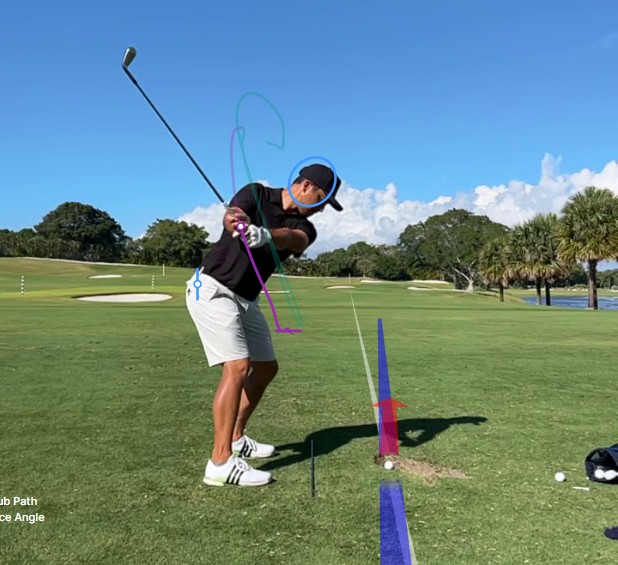
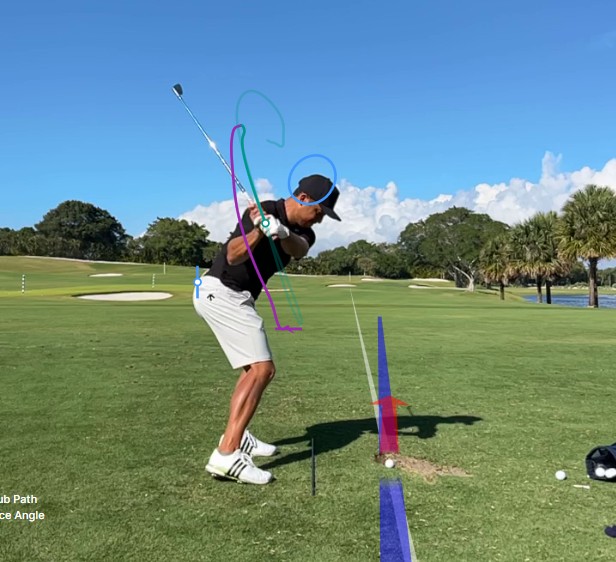
In the tour example, the hand trail shows a subtle but important feature: the hands move slightly outward on the downswing while the club reorganises behind them.
What the outward hand move is doing
- It preserves space for the arms to extend through impact.
- It prevents the club from becoming trapped behind the torso.
- It allows the centre of mass to rotate behind the hands without the player forcing a reroute.
Interpretation
The hands are not “dropping under plane”. They are continuing around the torso while the club’s centre of mass falls behind them and the shaft aligns into a stable delivery orientation.
7. Case study: +5 handicap delivery pattern
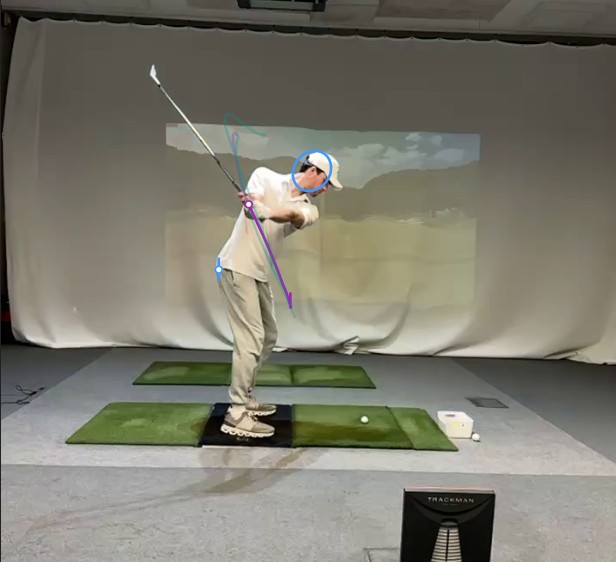
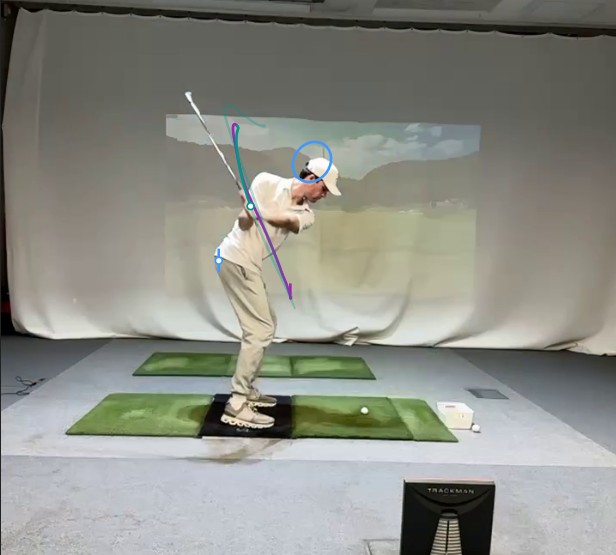
The +5 example is valuable because it shows how close high-level amateurs can be to tour delivery without looking identical. The key observation is that the hands largely track the same route up and down.
This is a hallmark of a swing driven by rotation rather than constantly rerouted by the arms. When the hands are stable, the club can be organised around them, which is why this player can produce elite-level scoring and ball control.
What is most important in these frames
- The hand corridor is stable relative to the torso.
- The club orientation changes around the hands through transition.
- The trail elbow is not flying outward, which reduces steepening pressure.
8. Direct comparison: plane relationships and hand trail differences
Both swings show a high-level trait: stable hand corridor. The difference is not who is “on plane”. The difference is how the hands move relative to the torso and how early the club’s centre of mass reorganises behind them.
Tour Pattern
- Hands: stable corridor with a small outward move in transition.
- Effect: creates space for extension and prevents the club from getting trapped.
- Centre of mass: reorganises behind the hands early, promoting stable shaft alignment.
- Delivery: pivot-driven corridor with minimal need for late rescue.
+5 Handicap Pattern
- Hands: corridor is stable and often overlaps strongly up and down.
- Effect: reliable geometry without excessive rerouting.
- Centre of mass: reorganises behind the hands, but often with slightly less outward space.
- Delivery: highly functional, sometimes with a marginally tighter corridor through the ball.
Why the outward hand move matters
When the hands move slightly outward in transition, the arms have room to extend while the torso continues rotating. This reduces the likelihood of the club being trapped behind the body. When the hands remain more inward, the delivery can still be excellent, but the corridor is narrower and the player may require slightly more precision in how the release unfolds.
Do Not Confuse Hand Path with Shaft Plane
A player can have a stable hand corridor and still show meaningful shaft plane change. This is normal. In many elite swings, the club reorganises behind the hands while the hands remain committed to the rotational corridor established by posture and turn.
9. How to diagnose whether plane is biomechanically stable
Plane stability is rarely solved by telling a player to be “more shallow” or “more on plane”. The better diagnostic is to assess whether the delivery is being produced by rotational geometry or by compensations.
Green flags
- Hand corridor stability: hands do not dramatically drop under or throw over the backswing path.
- Club reorganisation: shaft changes orientation behind the hands without a forced reroute.
- Continuous rotation: pelvis and thorax keep moving, rather than stalling and requiring hand rescue.
- Trail elbow behaviour: elbow works down and in rather than up and out.
Red flags
- Hands forced under: exaggerated vertical hand drop often produces stuck delivery and late flip.
- Hands thrown out: hand path moves rapidly away from the torso early, steepening the shaft.
- Pivot stall: pelvis stops rotating and the player must square the face with timing.
- Elbow flare: trail elbow lifts outward, increasing steepness and out-to-in risk.
10. Training constraints that actually improve plane stability
If the aim is an optimum biomechanical plane, training must target the underlying constraints, not the visual plane.
A. Hand corridor constraint
Use a simple external reference that encourages the hands to keep rotating around the torso without being forced down. The goal is not to keep the club on a stick. The goal is to keep the hands on a predictable corridor.
B. Trail elbow constraint
The elbow should feel as if it is working down toward the rib cage in transition, not throwing out toward the ball line.
C. Pivot continuation constraint
A stable plane requires continuous rotation. If the pivot continues, hand corridor stability becomes easier and the club can reorganise naturally.
Practical Rule
Do not train “plane”. Train the constraints that stabilise hand corridor and centre-of-mass behaviour in transition. The plane becomes the outcome rather than the target.
11. Practical summary
The optimum biomechanical swing plane is not a single visual line. It is the stable three-dimensional arc that emerges when:
- the torso rotates on a tilted axis,
- the hands track a predictable corridor relative to the chest,
- the club’s centre of mass is allowed to reorganise behind the hands in transition,
- the trail elbow supports the change in lever geometry rather than steepening it,
- the player does not require late compensations to find the ball.
In both examples, the hand trail tells the truth. When the hands remain organised around the torso’s geometry, the club can change orientation around them and deliver a stable plane. Differences between players are usually differences in corridor width and timing, not a difference between “on plane” and “off plane”.
Work with Chris Brook
If you want a swing plane and delivery pattern built on biomechanics rather than guesswork, the process begins with diagnosis of the real constraint: rotation, arm structure, elbow mechanics, or club delivery geometry.
UK studio sessions and online coaching for international players. Diagnostics integrate biomechanics, perception, and performance behaviour.