Vertical Demand
What flight and carry the shot needs to reach the landing area, and what it has to clear.
New book · Pre-order now
The four-step read that tells you which shot to play, from any lie.
The V.E.R.T. Method for every shot inside 100 yards: read the lie, see how the ball will come out, check it can deliver the shot you want, and if it can’t, choose the option that leaves your best next shot.
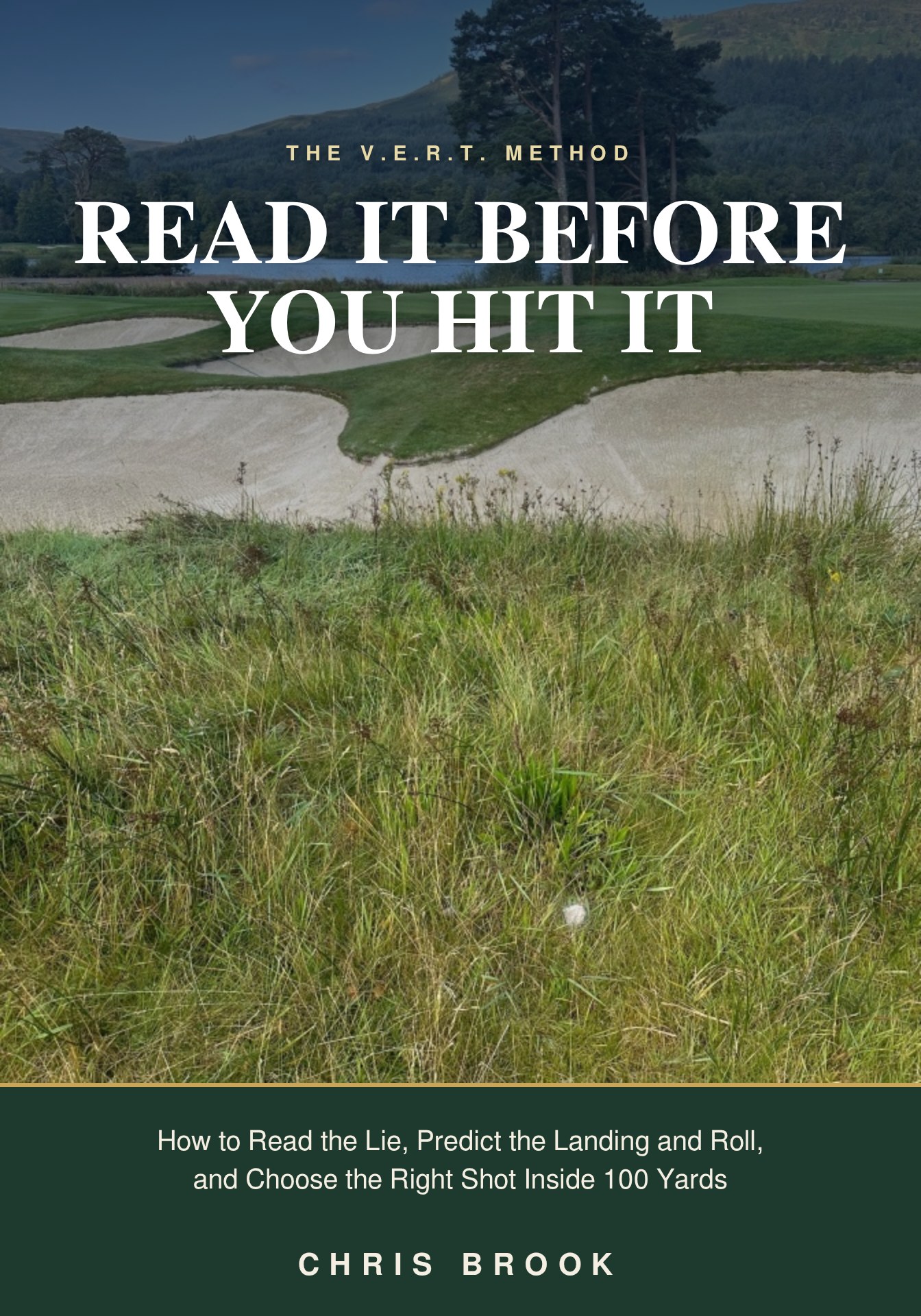
How to Read the Lie, Predict the Landing and Roll, and Choose the Right Shot Inside 100 Yards
Pre-launch offer · released November 2026
£25 £20 when you pre-order
Use code NHXBRIHYAT at checkout to save £5
Hardback · Paperback · Kindle eBook · Also on Amazon UK and Amazon US
By Chris Brook, short-game and putting coach for three decades, to tour professionals and international players.
 Your ball
How the read works
Most golfers pick the shot they want, then hope the lie lets them play it. The V.E.R.T. read works the other way round, and once you know it, it takes seconds.
How will the ball come out? Launch, speed and spin.
What does this shot need? Height and carry, landing, release, and what a miss will cost.
Can the way the ball comes out deliver what the shot needs? If it can, play it.
What are the other options, and which one leaves you the best next shot?
It works at every level, because it’s a decision, not a swing change. You choose a shot the lie will let you play.
Worked example: the lie in the photo
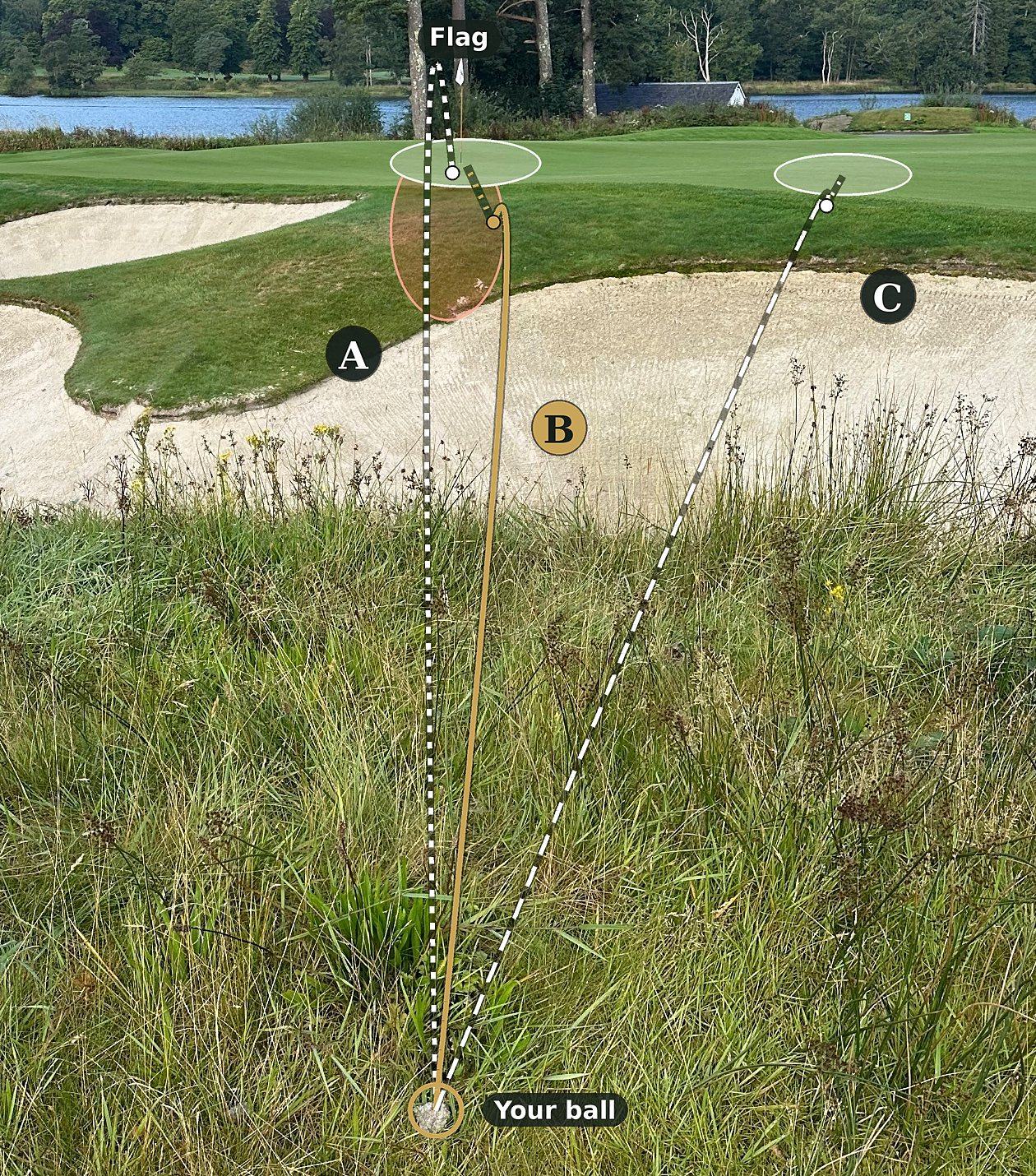
The ball is sitting down in long grass, with sand to carry and the flag cut just beyond it. Here’s how the four steps play out.
Grass will get between the face and the ball. Expect less spin, a launch that’s harder to control, and more release than normal. The grass will also slow the club.
To finish by the flag, the ball must carry the sand (high V), land softly just over it (precise E) and stop quickly (low R). Short is in the bunker (severe T).
You can get the height with a committed swing. You can’t get the stop: without spin, the ball will release. The shot the flag asks for isn’t on from this lie.
Weigh the options below by where each one leaves your next shot.
Your shot
B. It doesn’t need the lie to do something it can’t, and its miss still leaves a putt, not a bunker shot.
Under pressure
“Commit, and swing through the grass.”
The book teaches this read for 156 lies and conditions, and works through 20 complete scenarios like this one, each with plan and side views of every option.
What you’ll be able to do
The V.E.R.T. Method
The Lie Difficulty Scale rates how the ball will come out. The four V.E.R.T. ratings describe what the shot needs. Put them side by side and you can see whether the lie can deliver the shot, and, if it can’t, which option leaves the best next one. Once you know it, the read takes seconds.
What flight and carry the shot needs to reach the landing area, and what it has to clear.
How the ball must land, and what the first bounce will do.
How it will check, bounce, break and roll out to its finish.
How much room there is for error, and what a miss will cost you.
What’s Inside
You don’t read it cover to cover. Learn the read once in Part One, then look up the lies you meet in Part Two, like a field guide. Part Three builds your stock shots and Part Four tests your judgement on complete situations.
Tight turf, wet rough, plugged bunker lies, grain, slopes and wind, each with a flight diagram.
From simple chips to 90-yard pitches, with plan and side views of every option.
One shared language for how hard a lie really is.
A plan that turns your predictions into stock shots you can trust.
Reading the lie, the four ratings, comparing options and an on-course routine you can complete at playing speed.
Every entry shows how the ball comes out: launch, speed, spin, flight, landing and release, set against your V.E.R.T. read.
Build stock shots, read slopes with your feet, learn the day’s surface and record what your ball really does.
Complete situations read, scored and decided, so you can check your judgement against a worked answer.
Look Inside
Every one of the 156 entries follows the same pattern, so you always know where to find the answer.
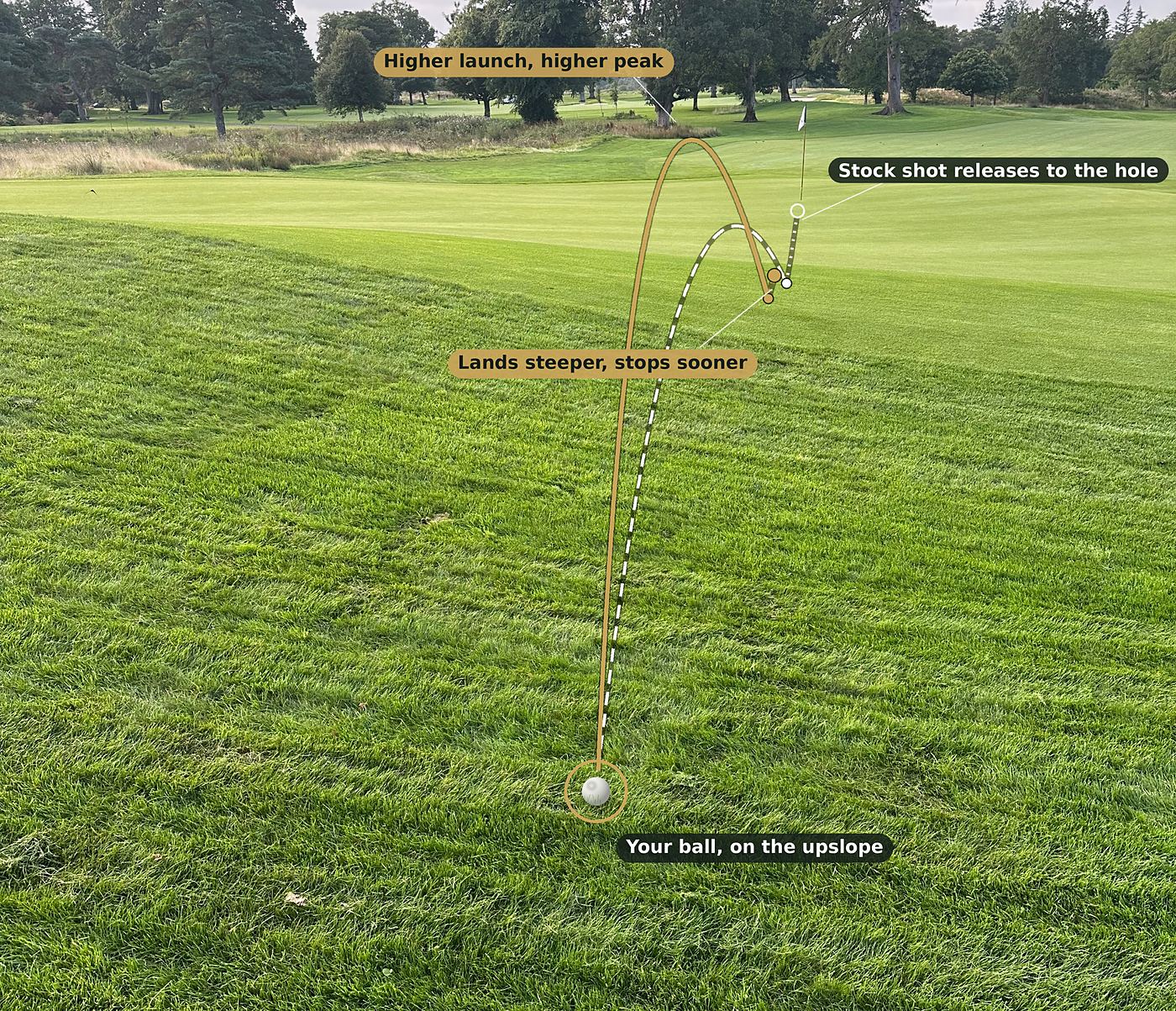
Your ball has stopped on the upslope of a mound 30 yards short of the green, with the ground rising towards the target. The flag is cut 6 yards on from the front edge of a firm green.
Pre-launch offer · released November 2026
£25 £20 when you pre-order
Use code NHXBRIHYAT at checkout to save £5
Why This Book Is Different
It works alongside whatever technique you already use.
| A typical short-game book | Read It Before You Hit It |
|---|---|
| Teaches the swing for a few stock shots | Teaches you to read 156 lies and conditions before you choose |
| Assumes a clean lie and a flat green | Shows how the ball comes out of each lie, and how it lands and releases |
| Tells you what to do | Gives you a scale and four ratings so you can decide for yourself |
| Leaves pressure for another book | Names how pressure causes each miss, with a cue to bring your read back |
| Judges every shot by getting it close | Chooses the option that leaves the best next shot, even when that isn’t the one at the flag |
Is It For You?
Short-Game Coaching with Chris
Short-game and putting coaching is Chris’s speciality. The book teaches you to choose the right shot. Coaching makes sure you can play it, from the lies you actually face, and that it holds up when the score matters.
Strike, low point, face and loft delivery measured rather than guessed, so your stock shots carry and release the way your read predicts.
From clean sand to plugged and downslope lies, reading how the ball will come out before choosing what to play.
Putting analysis shows how your stroke and start line really behave, alongside reading slope and speed on the green.
The “Under pressure” cues from the book, built into your routine so the decision you made holds when consequence rises.
Go Further
Every “Under pressure” cue in this book draws on Chris’s golf psychology work.
For golfers whose perception, confidence or decision-making changes when the scorecard becomes meaningful.
Explore the Golf Psychology BookTen audio lessons and ten workbooks on pressure, expectation, self-interference and recovery. Lifetime access for £59.
Explore the Structured CourseFor golfers who can produce a movement in practice, yet cannot make the change hold on the course.
Explore the Swing-Change BookRead and play real lies with Chris near Bournemouth, with 3D biomechanics where the read shows a shot you cannot yet produce.
Book a SessionQuestions
Yes. Pre-order before the November 2026 release and use code NHXBRIHYAT at checkout to save £5, bringing the price from £25 to £20.
No. This is not a swing-change book. It teaches the read and the decision that sit on top of whatever technique you, or your coach, already use, and it shows you which shots are worth practising.
You don’t read it all at once. Part One teaches the method in an evening or two. Part Two is a reference of 156 lies you dip into when you meet them, on the practice ground or before a round.
Any golfer who can make reasonable contact around the green. Higher handicappers learn to choose the shot that keeps a mistake small; low handicappers learn to read lies and releases more precisely.
The scale and ratings are for learning in practice and pre-round study, so the read becomes your own judgement on the course.
Every reference entry ends with an “Under pressure” cue built on the Feel, Breathe, Name, Direct loop from that book.
Yes. Short-game and putting coaching is Chris’s speciality. Sessions take place near Bournemouth in Dorset, online in real time, or at tournaments and your own base, and use the same V.E.R.T. read taught in the book. Book a session.
The book comes in hardback, paperback and Kindle eBook. The print editions show the diagrams largest; on Kindle they’re best on a tablet. The pre-order offer is available through Chris’s own shop, and the book is also listed on Amazon UK and Amazon US.
Read It Before You Hit It
Know how the ball will come out, whether it can deliver the shot you want, and which option leaves your best next shot. Pre-order now and save £5 before the November release.
Pre-launch offer · released November 2026
£25 £20 when you pre-order
Use code NHXBRIHYAT at checkout to save £5