Access is not ownership
Producing a movement during rehearsal proves that it is accessible in that moment. Ownership requires the pattern to remain available under a wider range of speeds, shots and conditions.
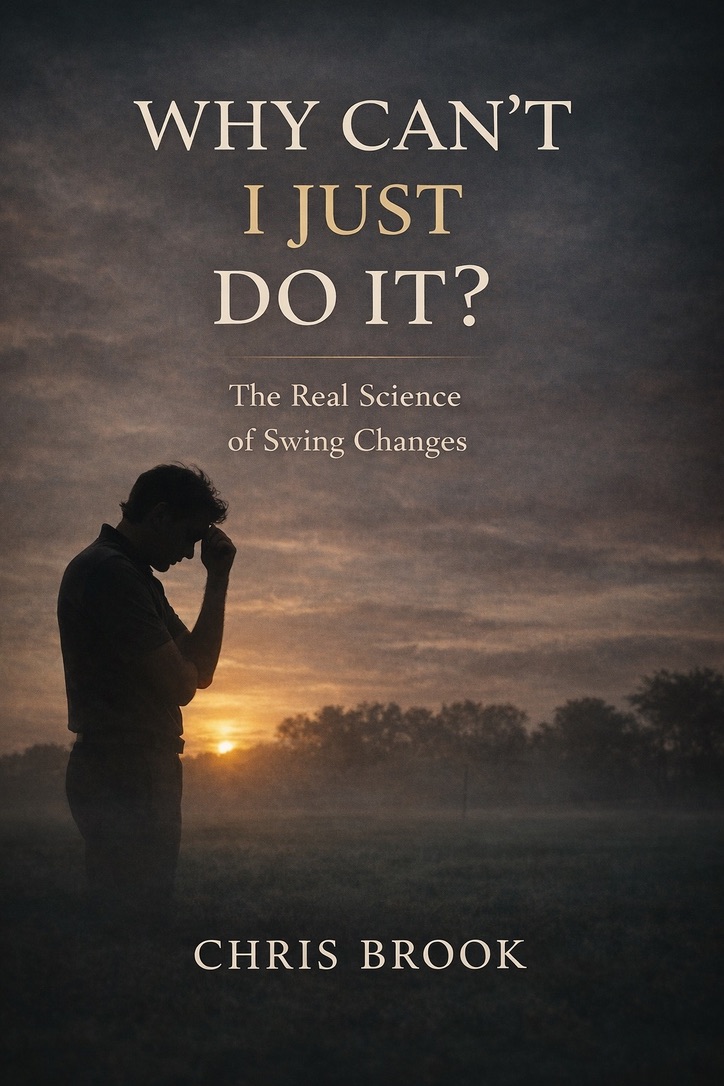
The Real Science of Swing Changes
Understand why a swing change can feel clear in a lesson, appear on the range and then disappear when speed, score or consequence enters the task.
Chris Brook’s second book investigates the difficult gap between knowing what to do and being able to reproduce it when the round becomes real. It explains why early success is not the same as ownership, why familiar patterns can return and why lasting change has to survive more than repetition in a controlled practice environment.
This is not another collection of swing positions or quick fixes. It gives golfers and coaches a clearer framework for movement learning, integration and on-course transfer—so regression can be understood rather than treated as proof that the change has failed.
Why the book exists
A golfer can understand a movement, produce it during a lesson and repeat it in practice without yet having made it sufficiently stable. The lesson reduces uncertainty. Rehearsal slows the task down. Repetition creates temporary familiarity. None of those conditions fully reproduces the combination of speed, target, score, consequence and limited attempts found on the course.
When the new movement becomes less available, golfers often blame commitment, discipline or confidence. Those factors can matter, but they do not explain the entire problem. The movement may still require conscious supervision, may not yet be organised at playing speed or may not remain accessible when attention and emotional state change.
The book gives the reader a more accurate way to interpret that experience. Instead of mistaking temporary access for permanent ownership, the golfer can recognise what stage the change has reached, what the course is revealing and what still needs to be built.
In the lesson
On the course
Inside the book
Swing change is still a technical process, but technique is learned and reproduced by a person whose attention, perception, emotion and behaviour change with the environment.
Producing a movement during rehearsal proves that it is accessible in that moment. Ownership requires the pattern to remain available under a wider range of speeds, shots and conditions.
A range repetition and a scored shot do not place identical demands on the golfer. Target, consequence, uncertainty and the absence of a second attempt all influence execution.
An established movement has years of organisation behind it. It may return when the new solution is not yet stable enough for the speed or demand of the shot.
A change that depends on several conscious instructions is vulnerable. Under pressure, the golfer may supervise the body more intensely just as attention is needed for the shot.
A strong session is encouraging, but it does not show how the movement responds to fatigue, variability, consequence or time away from practice.
The return of an old pattern is not automatically failure. It can reveal which demand exceeded the new organisation and where the development process remains incomplete.
A clearer development model
The book distinguishes immediate change from integration and transfer. Confusing these achievements is one of the main reasons golfers overestimate early progress, then feel defeated when the movement becomes less reliable.
Access. The golfer can find and produce the new movement in a supported, controlled setting.
The lessonIntegration. The movement becomes less dependent on conscious control and more tolerant of speed, variability and imperfect rehearsal.
PracticeTransfer. The golfer can organise the movement around the shot when target, score, consequence and only one attempt make the task real.
The courseWhat makes it different
The book looks beyond the visible position to the conditions under which the movement is being produced. It connects biomechanics with learning, attention, perception, emotional state and the demands of the playing environment.
The reader is not told simply to commit harder, repeat more or stay positive. The aim is to identify whether the barrier is technical clarity, physical organisation, conscious overload, insufficient variability or incomplete transfer.
A quick fix can make the golfer feel better today without creating anything durable. The book helps the reader resist that cycle: protect what works, understand what the setback is revealing and continue building the part of the change that is not yet ready.
Book information
£12.99
Published by Serion Publishing and available through Amazon UK and Amazon US. Retail price and availability may change on Amazon.
£9.99
Secure Payhip checkout with digital delivery after purchase.
Related reading
These long-form articles develop the book’s central ideas through technique, learning, emotion and the difference between understanding and implementation.
Why a change can feel easy in practice yet collapse on the course—and how lasting development differs from a temporary breakthrough.
How emotion, self-protection and the need for immediate success can interfere with the implementation of a change.
A practical examination of quick fixes, repetition and the wider process required to make movement more durable.
Read more about biomechanics, technique, performance psychology, scoring, putting, speed and player development.
Where to go next
Read the book when you want a complete framework for why swing changes succeed in practice yet fail to transfer. Choose coaching when you want the specific biomechanical, learning or performance barrier within your own golf identified directly.
See every book and course, plus the upcoming podcast and webinars, on the Learn page.