Chris Brook specialises in golfers whose game is in adversity: form has gone, confidence has collapsed and golf has become a struggle. The work does not chase the game you have lost. It rebuilds from where you are now and builds a bulletproof performance mind that holds under pressure.
Live one-to-one online coaching • Adults aged 18+ • UK and international • Books and a self-paced course if you prefer to start on your own
Books & Course by Chris Brook
Golf psychology books and course
Start with the full explanation in a book or the self-paced course, or book coaching when you want the work applied directly to your own game.
Book · Pressure and scoring
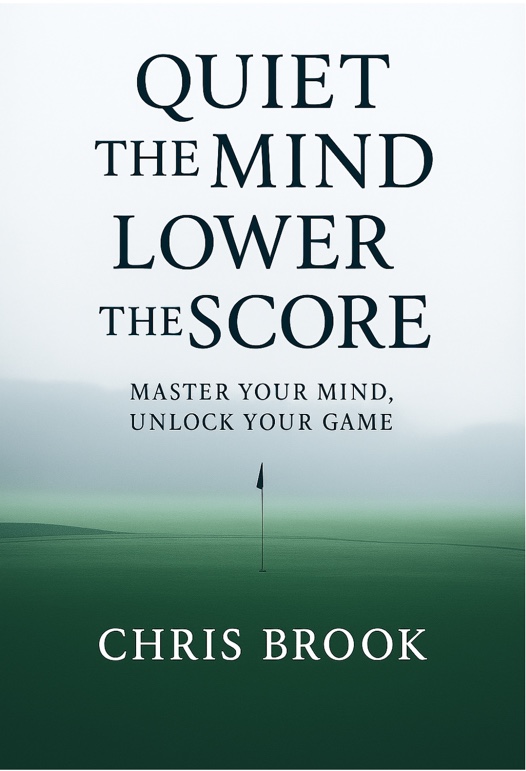
Quiet the Mind, Lower the Score
For golfers whose perception, confidence, emotional response or decision-making changes when the scorecard becomes meaningful. 25 chapters, 283 pages; eBook, paperback and hardback.
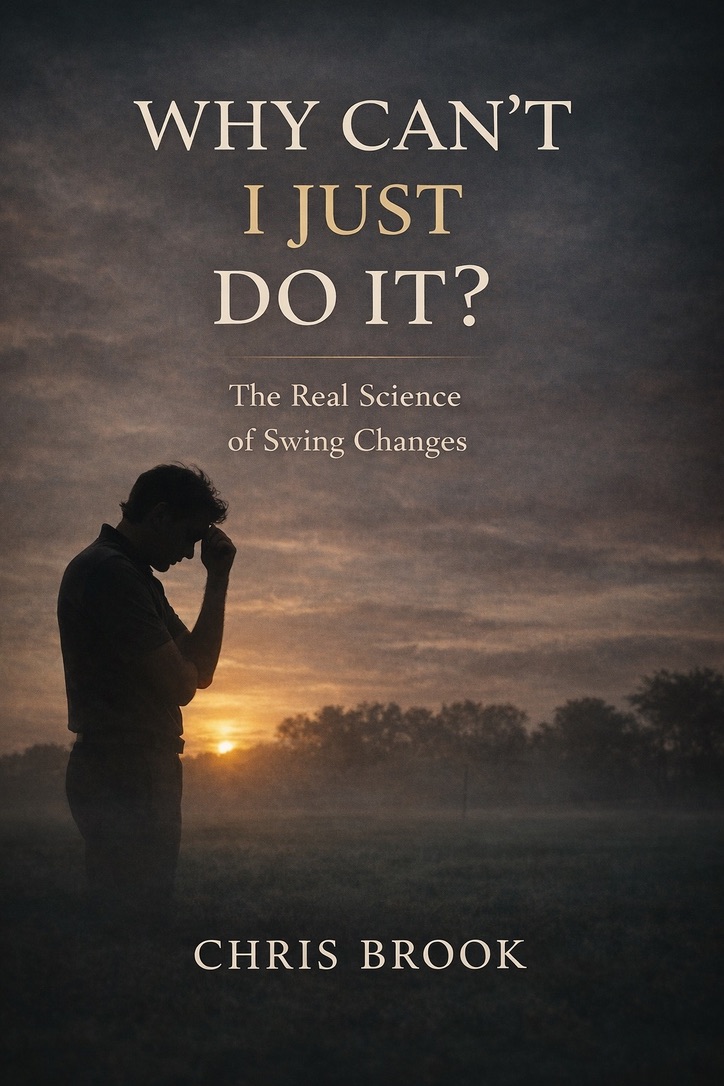
Which to choose? Quiet the Mind for pressure and scoring, Why Can’t I Just Do It? for swing changes that won’t hold, the course for structured study, and coaching when you want your own pattern examined directly.
When Your Golf Is in Adversity
Don’t chase what was lost. Rebuild something stronger.
Many golfers come to Chris when their game is in a difficult place. Scores have gone up. Shots that used to be automatic now feel fragile. Confidence has drained away, and golf that was once enjoyable has become a source of frustration or even dread. The game they had seems to belong to someone else.
The natural response is to chase it: to search for the old feeling, the old swing thought, the old confidence. But chasing keeps the golfer measuring every round against a past version of themselves. Every shot becomes evidence of what has gone, pressure rises and the struggle deepens.
Chris’s approach is different. Rather than trying to restore what was there before, the work starts from where your golf is now. It examines what has changed, what you have come to believe about your game and what is keeping the pattern in place, then rebuilds a performance mind designed for the conditions that broke the old one: one that holds under pressure, after mistakes and when the round matters.
A bulletproof performance mind is not one that never feels pressure or doubt. It is one that keeps working when they arrive.
Is Direct Coaching Right for You?
Choose coaching when the problem needs to become personal
The books and course explain the framework. Coaching is the better route when you want your own patterns, reactions and playing history examined rather than general principles alone.
This may be the right route if you:
feel your game is in a slump and you keep chasing the form you used to have
practise better than you score
become tense, careful or controlling under pressure
allow one mistake to influence several later shots
understand mental-game ideas but cannot apply them reliably
want a direct diagnosis rather than another collection of tips
This coaching is not:
generic positive-thinking instruction
a promise to remove nerves or uncertainty
a replacement for technical diagnosis when mechanics are the problem
motivational theatre or an elaborate pre-shot ritual
a guarantee of a particular score or outcome
The Chris Brook Clarity Method
Psychology is central, but it is never isolated
The Clarity Method brings biomechanics, performance psychology and performance identity into one diagnostic framework. On this service, psychology is the central area of work, while the other two pillars provide the context needed to avoid a false diagnosis.
Biomechanics
Technique matters because not every poor shot is a mental problem. Relevant movement or ball-flight information helps separate a genuine mechanical limitation from a pressure response.
Performance Psychology
This is the primary coaching layer: attention, perception, expectation, emotional reaction, decision quality and the golfer’s response to consequence.
Performance Identity
This examines what score and performance come to mean about the golfer, and why fear of failure, comparison or self-judgement can make each shot carry too much weight.
The work is grounded in what actually happens on the course. Rather than treating the problem as one negative thought, we examine the sequence that changes the player’s behaviour.
Pressure Response
What changes physically and mentally when score, first tee nerves or competitive consequence rises.
Attention and Perception
What the golfer notices, monitors or tries to control, and how that alters commitment and decision quality.
Reaction and Recovery
How meaning is attached to a poor shot and how quickly that reaction begins influencing the next task.
Behaviour Across the Round
How walking, self-talk, routines, risk choices and vigilance either stabilise or compound the pattern.
The Coaching Process
How an online session works
You do not need to arrive with a perfect explanation. Bring the situations that keep repeating. The purpose of the conversation is to make the pattern clearer and decide what deserves attention first.
1
Describe the change
We identify where your golf differs between practice, ordinary play and meaningful scoring conditions.
2
Map the sequence
We examine the triggers, interpretations, physical responses, decisions and reactions surrounding the breakdown.
3
Find the leverage point
We separate causes from symptoms and identify the smallest useful change rather than adding more mental instructions.
4
Build the next experiment
You leave with a clear observation, behaviour or practice priority to test in real golf.
Current session length, price and available times are shown in the live booking calendar, so the information remains accurate when availability changes.
Depth of investigation, translated into practical clarity
For more than 30 years, Chris Brook has investigated why golfers can possess knowledge and skill yet lose access to both when pressure, speed, uncertainty or personal consequence rises. A central part of that work is with golfers whose game is in adversity, helping them stop chasing the golf they used to play and rebuild from where they are now.
That investigation now connects biomechanics, performance psychology and performance identity through the Chris Brook Clarity Method. The intention is not to make coaching more complicated. It is to look deeply enough that the golfer leaves with fewer, more accurate priorities.
Chris is the author of Quiet the Mind, Lower the Score, Why Can’t I Just Do It? and the forthcoming short-game book Read It Before You Hit It, whose “Under pressure” cues draw on this same psychology work. His coaching applies that body of work directly to the individual golfer’s patterns, decisions and performance environment.
It is live one-to-one coaching focused on how pressure, attention, perception, emotion, expectation and performance identity influence decisions and behaviour on the golf course.
Is this the same as seeing a golf psychologist?
No. Chris is a golf psychology and mental game coach, not a registered psychologist. The coaching focuses on how pressure, attention, expectation and identity affect your golf. If you are experiencing anxiety, low mood or other difficulties beyond golf, please speak to your GP or an HCPC-registered practitioner psychologist.
My game is in a slump and my confidence has gone. Can coaching help?
Yes. Working with golfers whose game is in adversity is a speciality of Chris’s coaching. The aim is not to chase the form you used to have. It is to understand what has changed and rebuild from where you are now, with a performance mind designed to hold under the conditions that broke the old one.
Can coaching help with first tee nerves or choking under pressure?
Yes. First tee nerves, tightening over the closing holes and losing the game you have in practice when the score matters are exactly the patterns this coaching examines. The aim is not to remove nerves, but to understand what they are changing and build a more useful response.
Is this the same as an online swing lesson?
No. The primary purpose is performance psychology rather than swing instruction. Relevant technique or ball-flight information can still be considered so that a mechanical problem is not incorrectly labelled as psychological.
Do I need to be a tournament golfer?
No. The service is for adult golfers who take their development seriously. The important issue is not playing status; it is whether you want to understand and work on a repeating performance pattern.
What should I prepare before the session?
Think of one or two recent examples that show the problem clearly: what was happening, what the shot or score meant to you, what changed and how you responded. Formal notes are optional.
Should I start with a book, the course or coaching?
Start with Quiet the Mind, Lower the Score if you want the full explanation of pressure and scoring behaviour, or Why Can’t I Just Do It? if a swing change will not hold on the course. Choose the Expect Less, Perform More course for structured self-study, and coaching when you want your own pattern examined directly. There is no need to complete every stage.
Can golfers outside the UK book?
Yes. Sessions are delivered online and are available internationally where the live calendar provides a suitable time.
How long is a session and what does it cost?
The current duration, price and available appointment times are displayed in the booking calendar. Keeping those details there prevents this page becoming inaccurate when the schedule or service changes.
Begin With the Pattern
Bring the part of your golf you cannot yet make sense of
If your golf is in adversity, direct coaching provides a place to understand what has changed and rebuild a performance mind that holds when it matters.