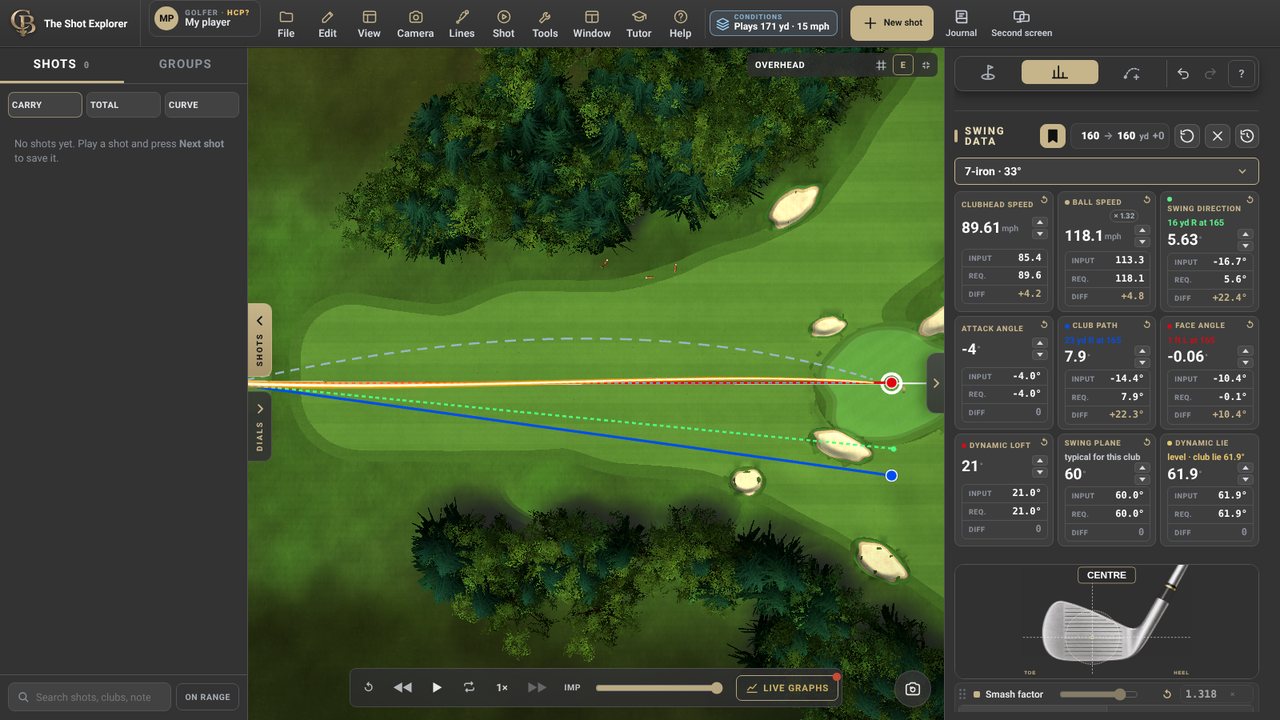
In a crosswind, holding the ball against the wind is the more stable shot. When I tested both in The Shot Explorer, the held 7-iron finished across a 23% narrower spread when the wind gusted, landed travelling straighter at the flag, rolled less, and gained twice the strokes of the ridden shot in a strong, gusting wind. It does cost some distance, and it cannot rescue a clubface the golfer does not control.
Most golfers have been taught a simple rule for a crosswind: go with it. If the wind is blowing left to right, aim left and let it bring the ball back. It sounds sensible, and it feels natural. But it is incomplete, and in a strong wind it is often the wrong decision. Elite players do not simply surrender the ball to the wind. Far more often they hold it against the wind, so the flight stays under their control rather than the weather’s.
To find out how much difference that really makes, I took the question into The Shot Explorer and flew the shots, again and again, in steady wind and in gusts. The results were clearer than most golfers would expect.
Which Would You Play?
The golfer is 165 yards out with a 7-iron. The flag is in the middle of the green, with bunkers either side, and the wind is blowing hard from left to right. There are two ways to play it.
Start the ball well left and let a fade and the wind carry it back to the flag.
Start the ball at the flag and draw it gently into the wind, so the spin and the wind cancel each other out.
Most club golfers choose A. In a 25 mph crosswind, that choice asks them to aim the clubface 17° left of the flag and swing 23° to the left of the target. That delivery is so extreme that The Shot Explorer will not even allow it to be entered. The serious question is not which shot looks natural. The serious question is which shot stays stable when the wind does what wind always does: change.
- 23% tighter in the gusts. With the wind gusting from 15 to 35 mph, the held ball finished across 32 yards. The ridden ball spread across 41 yards.
- Twice the strokes gained. In a strong, gusting wind, holding gained +0.22 strokes a shot. Riding gained +0.11.
- The face points at the flag. To hold a 15 mph wind, the clubface is aimed at the flag. To ride it, the face points 10° left of it.
- 37% less roll. In 25 mph the held ball rolled 2.9 yards after landing. The ridden ball rolled 4.6 yards, sideways, in the direction the wind was blowing.
How I Tested It
Every shot in this article was flown in The Shot Explorer, using its full ball-flight model. That model has been checked against real TrackMan shots from slow to fast swing speeds, and its wind strengthens with height, just as real wind does. Nothing was added to favour one shape over another. The ball simply does what the physics says it will do.
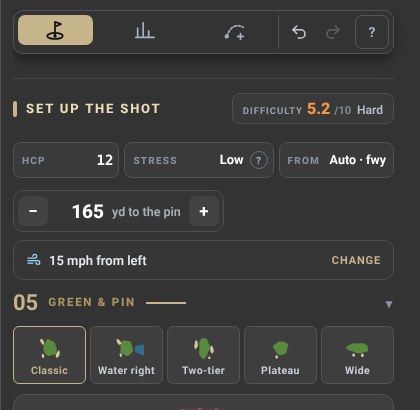
The test was built around a realistic approach: a 7-iron to a flag 165 yards away, in the middle of a green guarded by bunkers, played from the fairway by a 12-handicap, right-handed golfer with nothing much riding on the shot. The strike was a normal iron strike, slightly descending (attack angle −4°, dynamic loft 21°), from the middle of the clubface. The wind came from the left at a moderate 15 mph and a strong 25 mph.
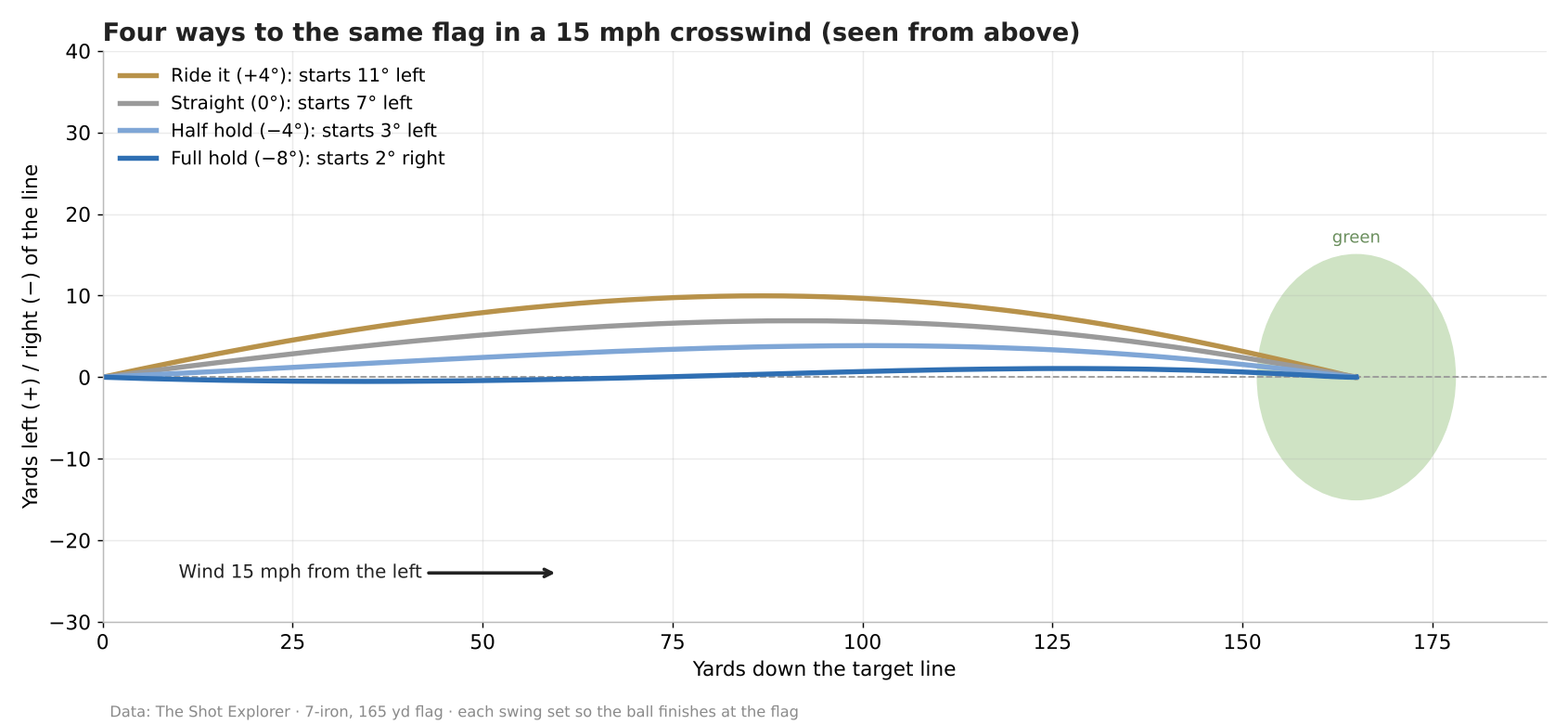
Each shape was given a fair chance. Every shot was set up so that, in the steady wind, the ball finished at the flag. Only then did I change the wind, and the strike, to see which shot held up. I compared four shapes, from riding the wind to fully holding it:
| Shape | Face to path | What the ball does |
|---|---|---|
| Ride it | +4° | A fade. Starts well left and curves right with the wind. |
| Straight | 0° | No curve from the spin. The wind alone moves it. |
| Half hold | −4° | A gentle draw that slows the wind’s push. |
| Full hold | −8° | A draw strong enough to beat the wind and bring the ball back to the flag. |
- Face (face angle): where the clubface points when it hits the ball. It decides most of where the ball starts.
- Club path: the direction the clubhead is travelling as it hits the ball.
- Face to path: the difference between the two. It decides which way, and how much, the ball curves. Plus curves it right (a fade), minus curves it left (a draw).
- Swing direction: the direction the whole swing is heading along the ground.
- Start line: the direction the ball starts out in.
- Spin axis: the tilt of the ball’s spin. Tilted left, the ball curves left. Tilted right, it curves right.
- Strokes gained: how many shots a shot saves (plus) or costs (minus), compared with a typical golfer of the same handicap.
Every angle in this article is measured from the line to the flag: L is left of it, R is right of it.
The Shot Explorer’s Tutor shows exactly why the two shots behave so differently. The red rod is the clubface and the blue rod is the club path. The gold bar through the ball is the spin axis, and its tilt is what curves the ball.
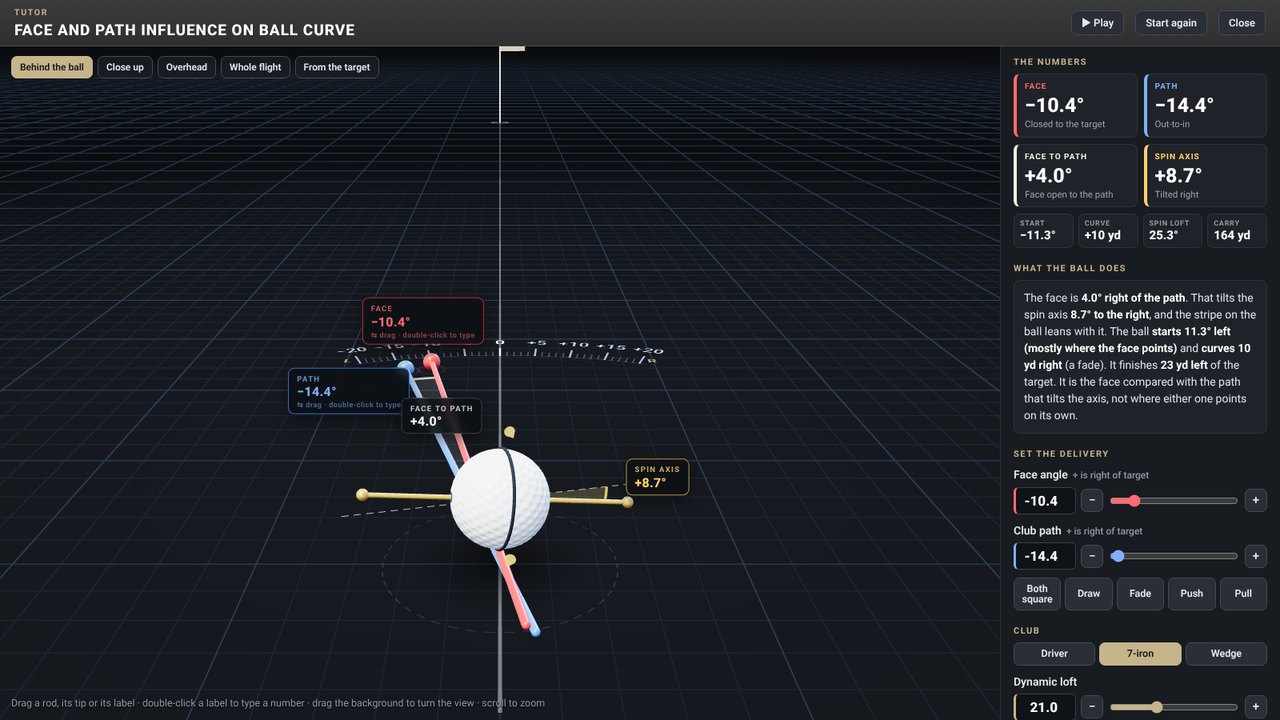
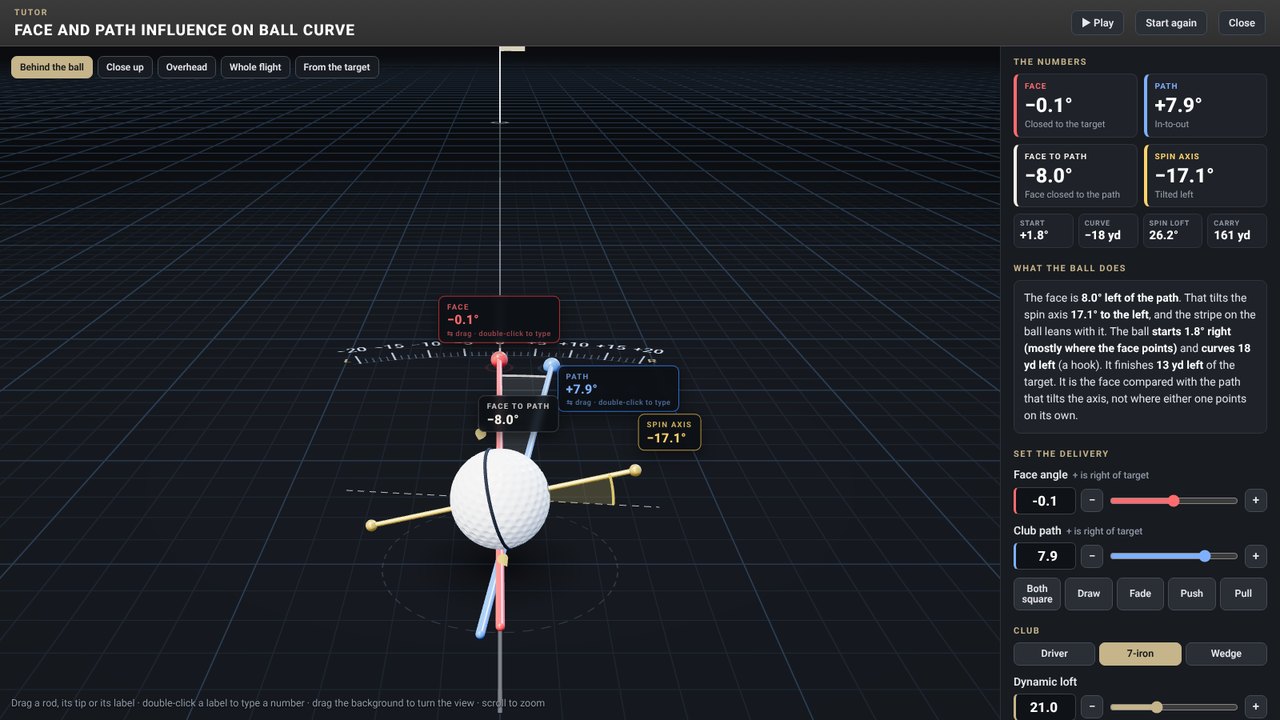
The Tutor shows the shape of the curve in still air. Out on the course, the wind then acts on top of it.
What Riding and Holding Look Like
The picture at the top of this article is the full hold. Below is the ridden shot, seen from overhead in The Shot Explorer. The red line is where the clubface pointed, the blue line is the club path and the green dotted line is the swing direction. The gold line is the ball.
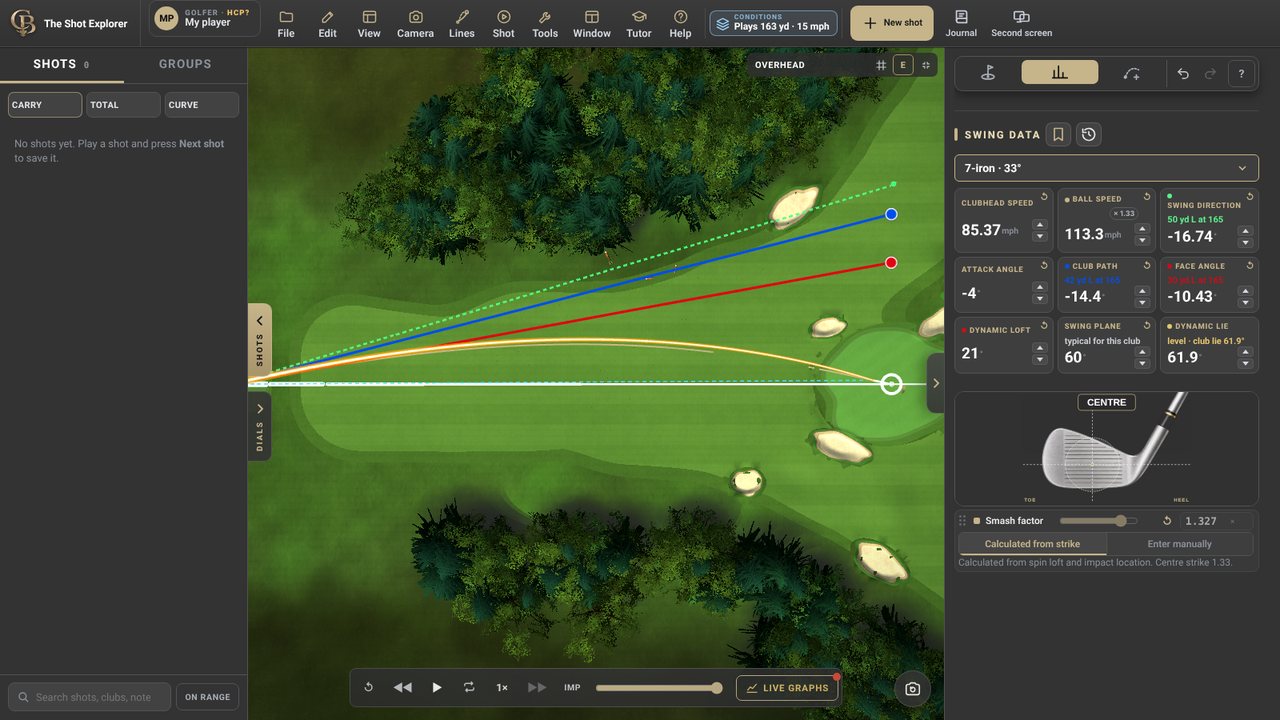
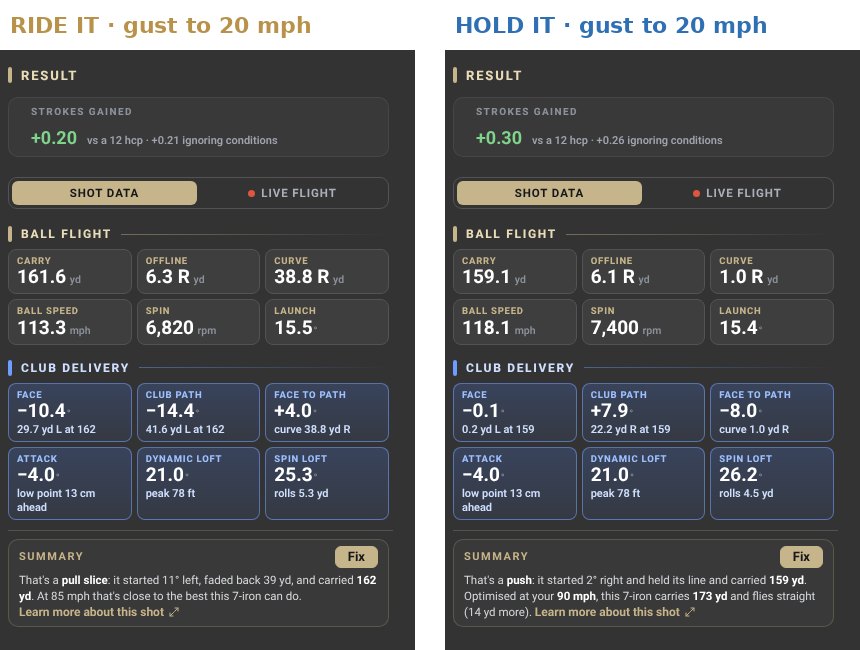
Now compare it with the hold. There, the face is aimed at the flag, just 0.1° left of it, and the path heads 7.9° right. The ball starts 2° right, holds its line against the wind and draws 5 yards back to the flag.
That distinction matters because it changes what the golfer is actually relying on. To ride the wind, the ball has to start a long way from the target: 11° left in a 15 mph wind and 18° left in 25 mph. The whole shot depends on the wind bringing it back. To hold it, the face points at the flag and the ball never strays far from the line. Look at where the trouble sits on the hole. Riding the wind asks the golfer to start the ball straight at it.
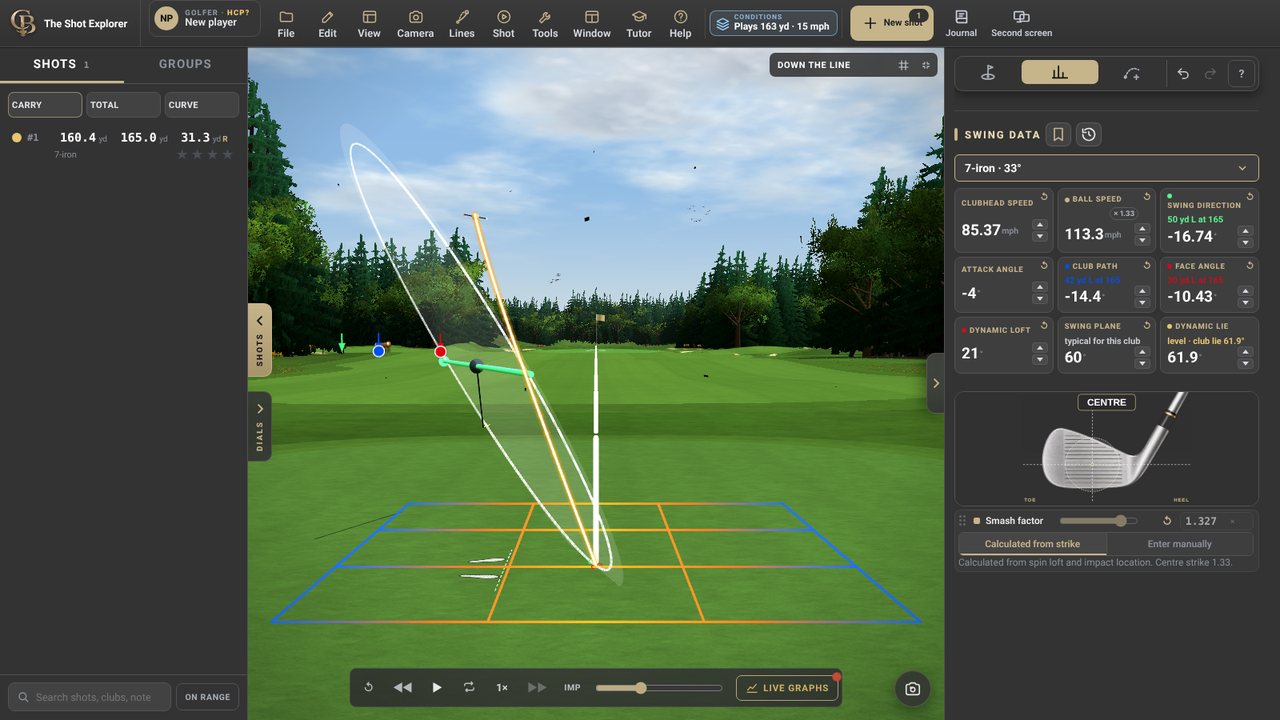
There is also a nervous-system cost to that. A target the golfer does not genuinely trust creates quiet internal threat, and threat affects commitment, freedom and timing. The ridden shot asks the player to aim at trouble and hope. The held shot gives him a target he can commit to. Why that matters is explained in Visualising the Shot and The Control Arena.
How Hard Is This Shot?
The Shot Explorer rates every shot out of 10 for the golfer playing it. It looks at the club and where the ball sits, the distance, the wind, the slope, the air, the green and its bunkers, and the pressure the player is under, and it measures all of that against what a golfer of that handicap can normally do.
| 7-iron from the fairway, 165 yards | Calm | 15 mph crosswind | 25 mph | Gust to 35 mph |
|---|---|---|---|---|
| 5 handicap | 3.2 Moderate | 4.0 Moderate | – | – |
| 12 handicap | 4.3 Moderate | 5.2 Hard | 5.8 Hard | 6.4 Hard |
| 20 handicap | 5.5 Hard | 6.6 Very hard | – | – |
Shot difficulty from The Shot Explorer. A 15 mph crosswind adds about one point for every golfer.
Here is the important part. The difficulty rating describes the situation, not the golfer’s answer to it. It is the same 5.2 whether the shot is ridden or held, because the wind, the lie and the green have not changed. What changes is the result. To judge the result, The Shot Explorer uses strokes gained, and that is where the two shots separate.
The Swing Each Shot Needs
These are the swing numbers each shot needs to finish at the flag. All four use the same 7-iron and the same strike.
15 mph wind from the left
| Shot | Clubhead speed | Swing direction | Club path | Face | Face to path | Start line | Spin axis | Spin |
|---|---|---|---|---|---|---|---|---|
| Ride it | 85.4 mph | 16.7° L | 14.4° L | 10.4° L | +4.0° | 11.4° L | 9.0° R | 6,820 rpm |
| Straight | 85.7 mph | 9.3° L | 7.0° L | 7.0° L | 0° | 7.0° L | 0° | 6,780 rpm |
| Half hold | 87.1 mph | 1.8° L | 0.5° R | 3.5° L | −4.0° | 2.6° L | 8.7° L | 6,960 rpm |
| Full hold | 89.6 mph | 5.6° R | 7.9° R | 0.1° L | −8.0° | 1.9° R | 17.2° L | 7,400 rpm |
25 mph wind from the left
| Shot | Clubhead speed | Swing direction | Club path | Face | Face to path | Start line | Spin axis | Spin |
|---|---|---|---|---|---|---|---|---|
| Ride it | 85.3 mph | 23.4° L | 21.0° L | 17.0° L | +4.0° | 18.0° L | 9.3° R | 6,820 rpm |
| Straight | 86.9 mph | 15.3° L | 13.0° L | 13.0° L | 0° | 13.0° L | 0° | 6,870 rpm |
| Half hold | 89.4 mph | 7.4° L | 5.1° L | 9.1° L | −4.0° | 8.2° L | 8.8° L | 7,150 rpm |
| Full hold | 93.2 mph | 0.5° R | 2.8° R | 5.2° L | −8.0° | 3.3° L | 17.1° L | 7,700 rpm |
From The Shot Explorer. Clubhead speed is what each shot needs to finish at a 165-yard flag in that wind.
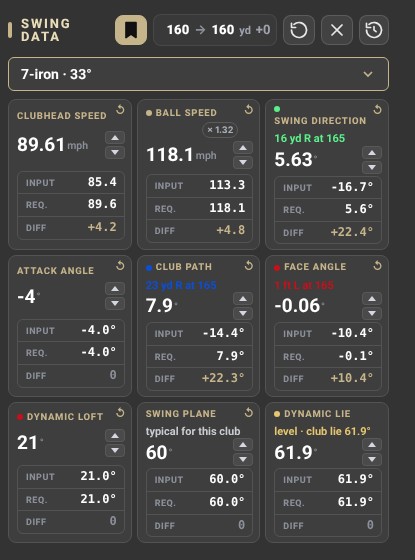
Look at the full hold in a 15 mph wind. The face points at the flag and the swing heads slightly right. That is simply a normal draw delivery, and the target remains the target. The ridden shot is a different matter. In 25 mph it needs the face 17° left of the flag and a swing direction 23° left. That is beyond what The Shot Explorer allows to be entered, at 15° of face and 20° of swing direction either way, because no golfer delivers it by design. Riding a strong wind is not a subtle adjustment. It is a distortion of the whole delivery. Holding keeps the aim, the face and the swing close to normal.
What Happens When the Wind Gusts
Steady wind is rare. The golfer sets up for 25 mph and a gust arrives at 35, or the wind drops to 15 just as he swings. So I kept each swing exactly the same and changed only the wind: 15, 20, 25, 30 and 35 mph. Each swing had been set to finish at the flag in 25 mph.
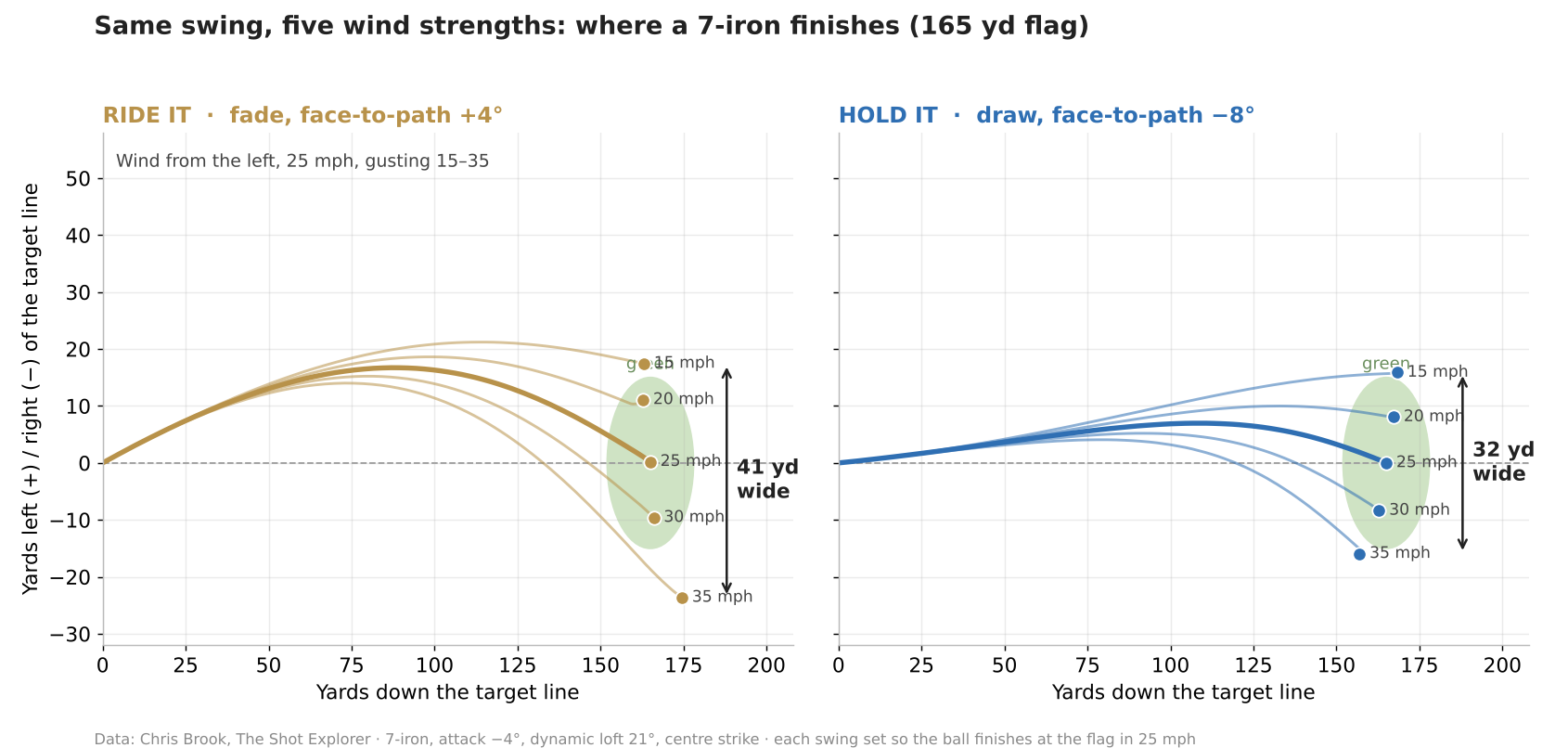
In a moderate 15 mph wind, gusting from 9 to 21 mph, the same pattern appears on a smaller scale: the ridden ball finished across 19 yards and the full hold across 16. The stronger and gustier the wind becomes, the wider the gap.
The reason is structural. When the golfer rides the wind, the fade spin and the wind push the ball the same way. The ball has to start far left so that both forces together bring it back, and every mile an hour of change in the wind lands straight on top of that large curve. When he holds it, the spin pushes against the wind. The ball starts near the line, the two forces largely cancel, and a change in the wind has far less to work with. Over a round, that variance is expensive.
What It Is Worth in Strokes Gained
Strokes gained compares where the ball finishes with where a golfer of the same handicap would expect to finish from the same spot. A plus number means the shot saved strokes. The Shot Explorer calculates it for every shot and allows for the wind, so a good result in hard conditions gets the credit it deserves.
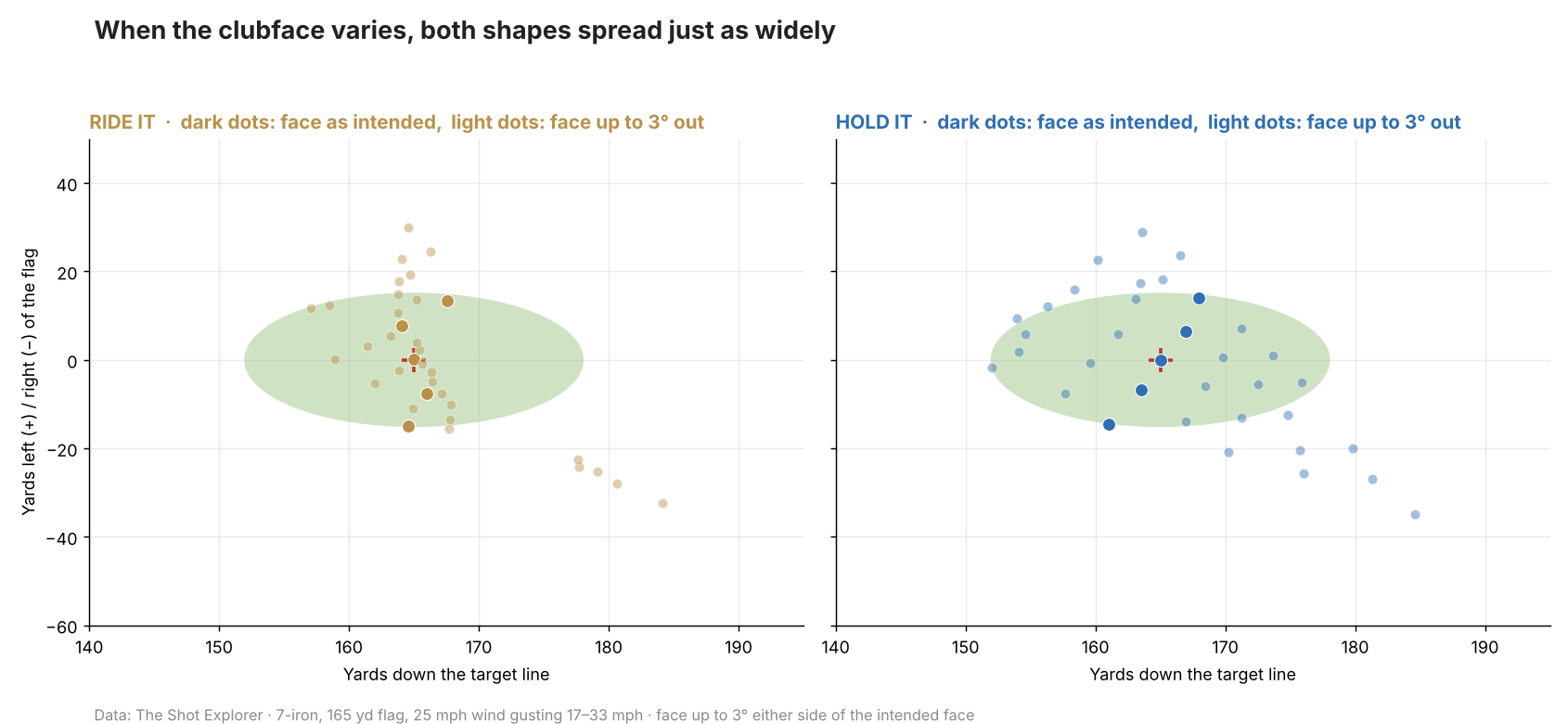
One shot proves very little, so I flew 49 versions of each shape: seven wind strengths and seven face angles, from 3° left to 3° right of the intended face. Small gusts and small face errors counted for more than large ones, because in a real round they happen far more often.
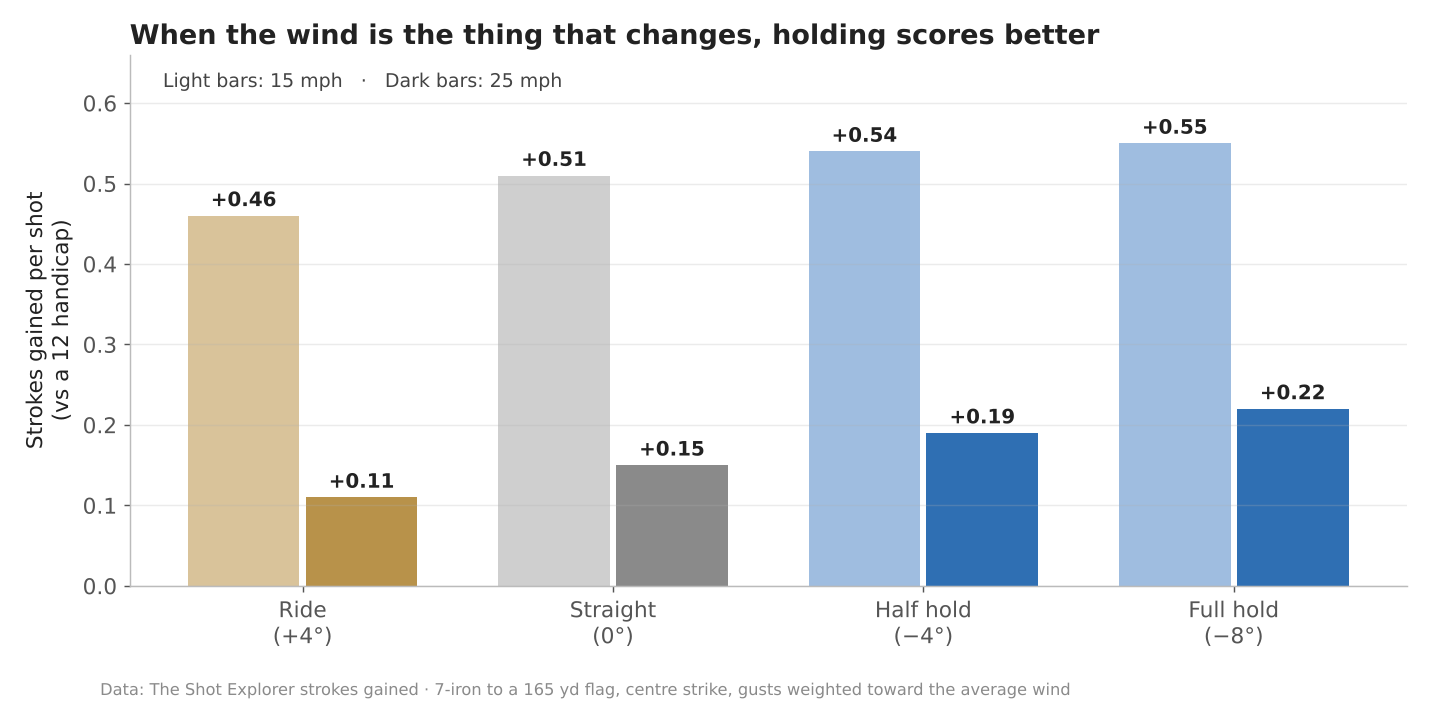
| 7-iron, 165 yards, 12 handicap | Ride | Straight | Half hold | Full hold |
|---|---|---|---|---|
| 15 mph, wind gusting, perfect strike | +0.46 | +0.51 | +0.54 | +0.55 |
| 25 mph, wind gusting, perfect strike | +0.11 | +0.15 | +0.19 | +0.22 |
| 15 mph, wind gusting and face varying | +0.32 | +0.31 | +0.29 | +0.27 |
| 25 mph, wind gusting and face varying | +0.15 | +0.12 | +0.11 | +0.12 |
Strokes gained per shot from The Shot Explorer, averaged over 48 shots for each shape. The one perfect shot, which goes in the hole for every shape, is left out.
The bottom two rows deserve careful attention. When the face angle varies as well as the wind, all four shapes score within about 0.05 strokes of each other. At that point the face is deciding where the ball goes far more than the shape is. Holding the shot removes the wind from the equation. It does not remove a wandering clubface from it. That is why face control remains the foundation, as explained in Driver Face Control at Moderate Speeds.
How the Ball Lands
Where the ball lands is only half the story. How it is travelling when it lands decides whether it stops, kicks or runs off the side of the green.
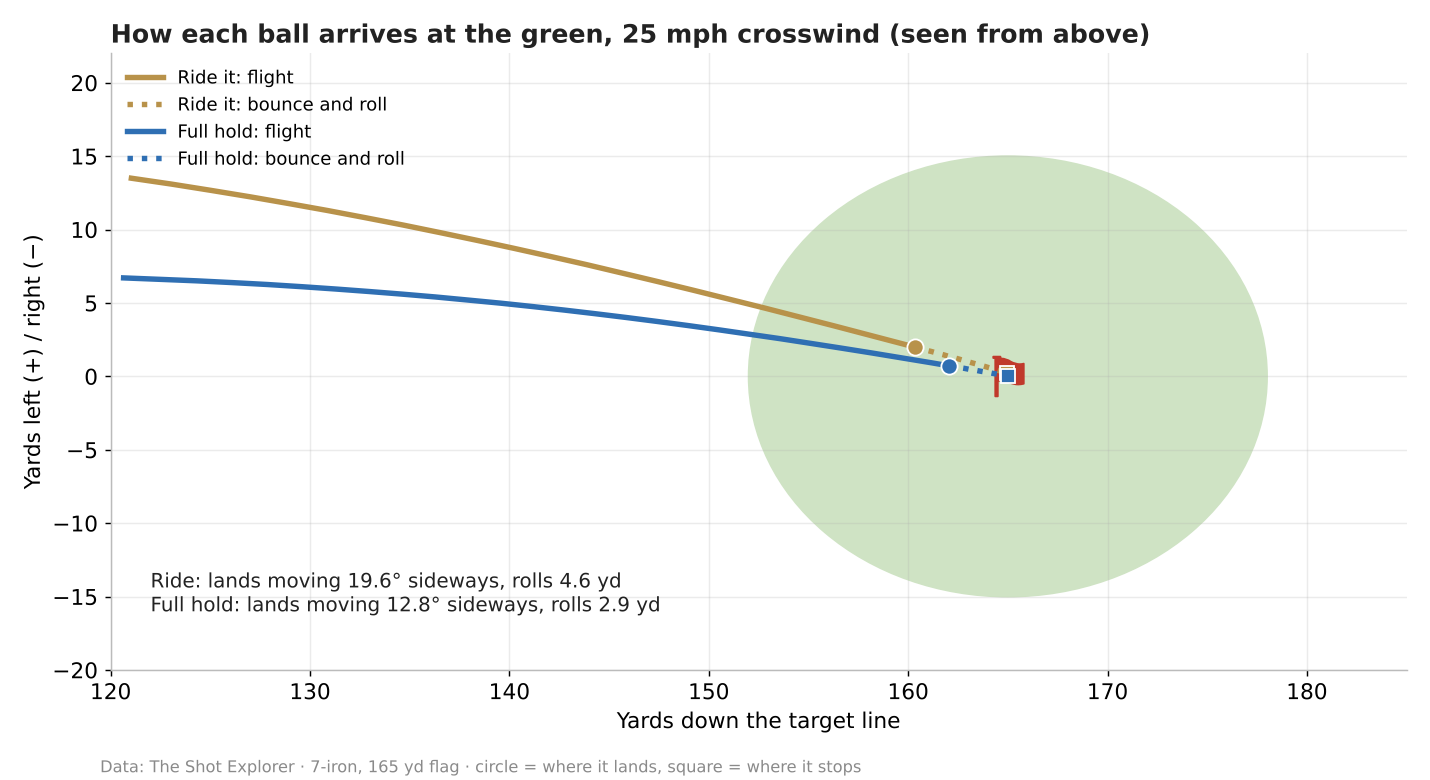
| 7-iron, 165 yards | Ride | Straight | Half hold | Full hold |
|---|---|---|---|---|
| 15 mph: travelling sideways at landing | 12.3° | 9.3° | 6.4° | 3.1° |
| 15 mph: landing angle | 42.0° | 43.0° | 43.9° | 44.7° |
| 25 mph: travelling sideways at landing | 19.6° | 17.6° | 15.3° | 12.8° |
| 25 mph: landing angle | 43.9° | 45.9° | 47.8° | 49.6° |
| 25 mph: roll after landing | 4.6 yd | 3.8 yd | 3.3 yd | 2.9 yd |
From The Shot Explorer flight and roll-out model, medium-firm green.
The held ball lands travelling much more nearly at the flag, and it comes in steeper. The ridden ball lands moving sideways, so its bounce and roll carry it further across the green in the direction the wind is already pushing. When the green is firm, or the trouble sits on the side the wind is blowing towards, that difference is the difference between a putt and a chip. The question is not simply whether the ball reached the green. The question is whether it arrived in a way that lets it stay there.
Where Holding Does Not Help
It would be easy to present holding the ball as the answer to every crosswind. It is not, and the data is honest about where it stops helping.
First, it needs more club. A ball curving into the wind meets some of it head-on, so it plays longer. The full hold needed about 4 mph more clubhead speed in a 15 mph wind and about 8 mph more in 25 mph. On the course, that means taking more club and swinging smoothly, not swinging harder.
Second, it does not rescue the face. When the face varied, the shape made almost no difference to strokes gained. A golfer who cannot yet control where the clubface points should address that first.
Third, the benefit grows with the wind. In a light breeze the difference is small. In 15 mph it is real but modest. In 25 mph and gusting, holding gained twice the strokes of riding.
Finally, the driver gains less. In 15 mph, a half-hold drive at 105 mph clubhead speed finished across 14 yards as the wind ran from 10 to 20 mph, against 16 yards for riding, but it carried about 7 yards shorter. Off the tee, the hold earns its place when the trouble is on the side the wind is blowing towards and finding the fairway matters more than distance.
How to Play It on the Course
The practical lesson is not that every golfer should fight every crosswind. The practical lesson is that the shape should be chosen by where the wind sends the ball and where that leaves the trouble. Serious golfers should work through four questions.
- Where does the wind put the trouble? If it is blowing towards a bunker, water or out of bounds, holding is the shot that keeps the ball away from it.
- Can the face stay on the flag? For a full hold, aim the clubface at the flag. For a half hold, a fraction left of it. Then set the curve with the swing, not the face, by swinging out to the right of where the face points: about 4° for a gentle hold and about 8° for a full one.
- Is there enough club? Take about one more club in a 15 mph crosswind for the full hold, and more in a strong wind. Swing at a normal pace. Swinging harder adds spin and height and gives the wind more to work with.
- Is this a line the body can genuinely commit to? The ball should start at, or just right of, the flag and stay there. If it drifts a little and comes back, the shot is working.
With the wind from the right, everything mirrors: the face at the flag, the swing to the left of where the face points, and a fade held against the wind. Left-handed golfers mirror it in the same way.
Final Conclusion
Riding the wind feels natural, but it asks the golfer to aim away from his target and hand the result to the weather. Every change in the wind lands straight on top of a large curve. Holding it against the wind keeps the clubface on the flag, keeps the ball near its line, and lets the wind and the spin cancel each other out.
The Shot Explorer shows the held shot moving less in the gusts, landing straighter, stopping more quickly and gaining more strokes whenever the wind is what changes. It also shows the limit: no shape can rescue a clubface that is not under control.
Do not judge a crosswind shot only by whether it can reach the flag. Judge it by how much of the result stays under your control when the wind changes.
Questions About Playing in a Crosswind
What does holding it against the wind mean in golf?
It means curving the ball into a crosswind instead of letting the wind carry it. In a wind from the left, a right-handed golfer starts the ball at or just right of the flag and draws it gently left, so the spin and the wind cancel each other out and the ball holds its line.
Is it better to ride the wind or hold it against the wind?
In the Shot Explorer tests, holding the ball against the wind was the more stable shot. When the wind gusted, the held 7-iron finished across a 23% narrower spread and gained more strokes. Riding the wind can still be the right choice when maximum distance matters and there is nothing on the side the wind is blowing towards.
How do I hold a golf ball against a left-to-right wind?
Aim the clubface at the flag and swing a few degrees to the right of where it points, so the face is closed compared with the swing. About 4° gives a gentle hold and about 8° a full one. Take more club and swing at a normal pace.
Why does a ball held against the wind go shorter?
A ball curving into a crosswind meets some of the wind head-on, so it plays longer than it would in calm air. In the tests, the full hold needed about one more club in a 15 mph crosswind.
Does holding the ball against the wind help with the driver?
A little. A half-hold drive finished in a tighter spread than a ridden drive, but it carried about 7 yards shorter. It is most useful off the tee when the trouble is on the side the wind is blowing towards and finding the fairway matters more than distance.