
Chris Brook has coached the short game and putting for three decades, working with tour professionals, international players and club golfers in his Dorset studio. His third book, Read It Before You Hit It, is published in November 2026. We asked him why he wrote it, what the V.E.R.T. Method is, and what changes when a golfer learns to read a shot before choosing it.
Why write a book about the short game?
Your first two books dealt with pressure and swing change. Why turn to chipping and pitching now?
Because so much of what I see around the green has nothing to do with the swing. A golfer chips past the hole, decides their technique has let them down, and goes off to work on it. Often the strike was fine. The ball came out of that lie exactly as it was always going to; the shot they chose simply could not do what they asked of it.
I wanted to give golfers a way to separate those things: the read, the choice and the execution. Without that, they end up repairing the wrong part of their game.
From the book
It is easy to blame your technique when the result is poor. Sometimes that is where the work is needed. But the mistake may have started before you took your stance. You may have asked the ball to check from a lie that offered little spin, chosen a landing spot that left too little room for release or attempted a flight you could not reliably produce.
A sound strike matters. So does knowing what that strike can achieve.
Read It Before You Hit It, Preface
If that sounds familiar, the same idea runs through my article Golf Tips Don’t Work: a quick fix aimed at the wrong cause rarely survives the golf course.
What goes wrong before the swing?
Describe the moment the book is written for.
Every golfer knows it. You are beside the green, the yardage is short, and you still do not know what shot to play. That uncertainty does not stay behind when you take your stance. It follows you into the swing.
From the book
You take a practice swing, then reconsider. Should you fly it farther or get it running sooner? Will it check or release? You change clubs, take another look and address the ball with those questions still unresolved.
Most golfers recognise this uncertainty. It can follow you into the swing, leaving you trying to adjust the shot when you should already be committed to playing it. You might steer the club, quit on the shot or add speed through impact because you have changed your mind about the carry.
Read It Before You Hit It, Preface
The yardage only tells you part of the story. Two pitches of the same distance can demand completely different shots, depending on the lie, the landing area and how the ball will release. That is why this book is about reading, not hitting.
What is the V.E.R.T. Method?
The book is built on the V.E.R.T. Method. What does it stand for?
It is a way of following the ball from the strike to where it finishes. Four connected questions, always asked in the same order, so you have a structure to lean on when the shot matters.
| Section | Main question |
|---|---|
| V — Vertical Demand | What flight and carry are needed to reach the intended landing area? |
| E — Entry Demand | How does the ball need to land, and what will the first bounce do? |
| R — Release Behaviour | How will it check, bounce, break and roll towards its finish? |
| T — Tolerance Severity | How much room is there for error, and what would a miss leave? |
Each part asks for a prediction and a rating. You explain what the ball needs to do, then judge how demanding that part of the shot is. The ratings combine with a lie rating into a Shot Difficulty Score, so you can compare options against the control you have actually shown in practice, rather than how confident or anxious you feel at that moment.
Reading the landing and release is the part most golfers skip. If you want to see why the target is not always the flag, read The Best Approach Shot Is Not the One Closest to the Hole.
Why does the lie come first?
You put the lie at the start of every read. Why?
Because the lie decides what the ball can do. You can plan the perfect high, soft pitch, but if there is grass between the face and the ball, that shot may not exist. So the first question is never “What do I want?” It is “What will this lie give me?”
From the book
“How is the ball likely to come out of this lie with the club and shot being considered?”
You then compare that expected flight with the requirements ahead. If the two do not fit, something in the plan has to change.
Read It Before You Hit It, Introduction
Once the ball leaves the face, the course owns it. Your job is to anticipate the sequence well enough, before you swing, to choose a shot that fits. That includes knowing how you use the club. The book asks whether you tend to dig or slide through the turf, because the same wedge behaves differently in different hands. There is more on what the club is really doing at impact in Forward Shaft Lean at Impact.
What does the book say about a ball sitting down in rough?
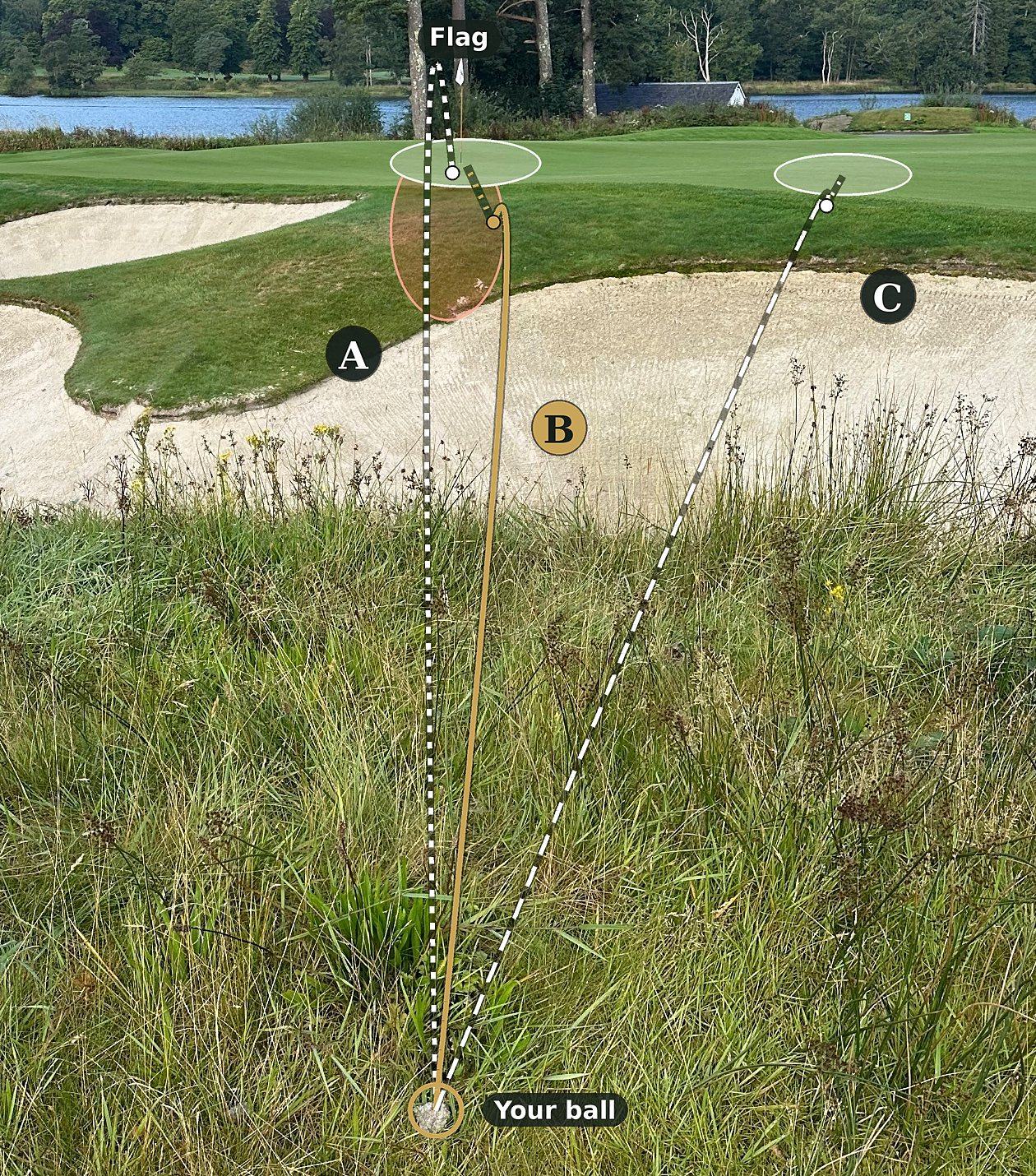
Take the photo at the top of this article. Ball down in the rough, sand between you and the flag. What does the book tell you?
That lie has its own entry in the reference section, alongside 155 others. Every entry follows the same pattern: how to read it, how the ball comes out, the likely misses, how pressure causes them, how to weigh your options and a drill. Here is part of that entry.
From the book · Entry 1.3, Ball sitting down
Spin: Much less than stock. Blades between face and cover stop the grooves grabbing, so the ball comes off with little bite.
Landing and release: Little check on the first bounce. Expect the ball to skid and release forward more than stock, so it runs out well past where it lands.
Under pressure: Seeing only half the ball is a strong trigger: the survival brain senses the grass will grab the club, and the flight response makes you ease off before impact. The club then dies in the grass, which is where the short miss with the twisted face comes from.
Read It Before You Hit It, Part Two
So the lob at the flag, the shot most golfers reach for, asks for exactly what this lie cannot give: height and a quick stop. That is where the bunker comes into play. The pressure part matters too. Easing off is not a technical fault; it is a reaction to what you see. I go much deeper into that in First-Tee Nerves and in my book Quiet the Mind, Lower the Score.
If the ball has found the sand rather than the grass, my article on Green Side Bunker Shots covers a simpler, more repeatable way out.
What does “choose the leave” mean?
One chapter is called “Choose the Leave”. What is a leave?
It is what you do when the read tells you the shot the flag asks for is not on. Most golfers either try it anyway and hope, or bail out somewhere that leaves a long putt. Both throw shots away. The book changes the question.
Which option leaves me no worse than a two-putt, with a real chance of a one-putt?
That question is built on how golfers actually putt, not on how we would like them to. The numbers in the book are worth knowing:
- A 15-handicapper holes 59% of putts from 3–6 feet, but only 22% from 9–12 feet and 9% from 18–24 feet (Shot Scope, 2025).
- 83% of amateur three-putts begin from more than 32 feet (Shot Scope, 2018).
- From inside 50 yards, a 15-handicapper’s average chip or pitch finishes about 18 feet from the hole (Shot Scope, 2025).
From the book
Distance decides. Slope breaks the tie. Choose the option whose finishes are shortest. Only when two options finish about the same distance away does being below the hole decide it.
Read It Before You Hit It, Chapter 10
The book applies this to the same kind of lie as the photo: sitting down in long grass, sand to carry, the flag just beyond. Three options. The lob fails on safety, because the heavy miss stays in the sand. Playing to the middle of the green is safe but leaves you 25 feet or more, where the three-putt is in play. Carrying the sand to land on the front and letting it release is the only option that passes every test.
Once you are on the green, the second half of the job begins. If distance control on the putt is your weakness, read The Geometry of Tempo: Why Perfect Rhythm Governs Elite Putting.
Isn’t this too much to think about on the course?
Four ratings, a lie score, a leave check. Won’t that slow golfers down?
No, because most of it happens before you reach the ball. You start reading the layout as you walk up. The lie check takes seconds. With practice you stop working each shot out from scratch and start recognising combinations you have seen before.
From the book
Pressure can make an ambitious shot feel necessary, or a manageable shot feel threatening. A structured routine gives you the same questions to answer in both circumstances.
The routine also needs to fit the pace of play. Gather information while approaching the ball and while others play, where appropriate. Inspect the relevant slope rather than every part of the green. Once the information is sufficient and the decision is made, move into your normal playing routine.
Read It Before You Hit It, Introduction
The point is commitment. When you know why you have chosen a shot, you stop changing your mind halfway through the swing. That is also why I am wary of detailed pictures at the moment of execution; I explain why in Visualising the Shot.
Short-game coaching
Learn the read on your own game
Short-game sessions in the Dorset studio and on the course use the same reading skills as the book, applied to your lies, your strike and your usual miss.
Explore short-game coachingHow should golfers practise it?
What does practice look like with this method?
You build stock shots you can trust, and you predict before every ball: where it will land, how it will bounce, how far it will release. Then you record what actually happened, including the heavy and thin ones. Your baseline is the range you really produce, not your best shot.
From the book
Separate three questions after every attempt:
Read: Did I correctly anticipate the flight, first bounce and release?
Execution: Did I produce the contact, carry and start line I intended?
Decision: Did the option give me a sensible chance of an acceptable finish, including my normal miss?A good strike can expose a poor read. A poor strike does not, by itself, disprove the read.
Read It Before You Hit It, Part Three
Taking that onto the course is the next step. My article On-Course Practice: 7 Training Rounds That Actually Improve Your Game gives you formats that make practice look like the game.
What is inside the book?
How is the book laid out?
In four parts, after an introduction that sets out the thinking behind the read.
- Part One — Learning the V.E.R.T. System. The lie check, the lie difficulty scale, each part of V.E.R.T., the Shot Difficulty Score, choosing the leave, practising the read and the on-course routine.
- Part Two — The Complete Golf Lies & Course Conditions Reference. 156 lies and conditions, from how the ball sits to sand, slopes, wind and weather, each with how the ball comes out, likely misses and a drill.
- Part Three — Practising the V.E.R.T. Process. Building stock shots, checking predictions and recording which combinations you can trust.
- Part Four — The Twenty Scenarios. Complete situations, from the simplest to the most demanding, to read yourself before comparing your choice with the options discussed.
You can read Part One in order and then use Part Two the way you would use an encyclopaedia: open it at the lie in front of you.
Who is it for?
Who will get the most from it?
Any golfer who has stood over a short shot unsure what to play, and that is every golfer. Club golfers will find a structure that stops them guessing. Better players will find the detail: how grass, firmness, grain and slope change the ball, and how to weigh options against their own numbers. Coaches will find a shared language for teaching shot selection, not just technique.
Technique, touch and practice still matter. The book does not replace them. It helps you put them to work with a clearer understanding of the shot in front of you.

Questions About the Book
What is Read It Before You Hit It about?
It is a short-game book by Chris Brook that teaches you to read the lie, predict the landing and roll, and choose the right shot inside 100 yards. It is built on the V.E.R.T. Method and includes a reference to 156 lies and conditions, 20 worked scenarios and a practice programme.
What does V.E.R.T. stand for?
Vertical Demand, Entry Demand, Release Behaviour and Tolerance Severity: the flight and carry needed, how the ball must land, how it will check and roll, and how much room there is for error. The lie is assessed alongside all four.
What is the Shot Difficulty Score?
Each part of the read is rated, together with a lie difficulty rating, and the ratings combine into a Shot Difficulty Score. It lets you compare options with the control you have shown in practice, rather than deciding on confidence alone.
What does choosing the leave mean?
When the shot the flag asks for is not available, you choose the option that leaves you no worse than a two-putt, with a real chance of a one-putt. Distance decides first; being below the hole breaks the tie.
Is the book only for low-handicap golfers?
No. Club golfers gain a structure that replaces guessing, and better players gain the detail on how grass, firmness, grain and slope change the ball. Technique and touch still matter; the book helps you use them on the right shot.
When is the book released and how much does it cost?
It is released in November 2026 in hardback, paperback and Kindle eBook. Pre-order through Chris Brook's website for £20 instead of £25 with the code NHXBRIHYAT.
Related Reading
For the strategy behind choosing a target, read The Best Approach Shot Is Not the One Closest to the Hole. For the sand, see Green Side Bunker Shots: Square Setup, Weak Grip & Distance Control, and for the putt that follows, The Geometry of Tempo: Why Perfect Rhythm Governs Elite Putting. If you want to know why the pressure of a short shot changes the swing, read the interview on Quiet the Mind, Lower the Score. You can also browse the complete collection of Golf Articles.