The Over-the-Top Hand Path Problem
Why the hands re-route, why the club cuts across, and how perceptual change rebuilds delivery. This article explains the over-the-top pattern through biomechanics, sequencing, threat, and motor organisation rather than generic swing advice.
The over-the-top golf swing is often described as a steep club delivery or an out-to-in club path, but that description misses the deeper issue. In many golfers, the true problem is an over-the-top hand path: the hands re-route outward in transition, the club is forced into a steeper delivery corridor, and the strike is rescued from above and outside. This article explains why that happens biomechanically, why threat and perception intensify it, and how a constraint drill can rebuild delivery by teaching the golfer a new, trusted hand path.
This article forms part of a connected swing-plane topic cluster with Optimum Biomechanical Swing Plane and The Myth of the Single Swing Plane, because over-the-top delivery is not only a club-path issue but a hand-path and delivery-plane problem that sits inside the larger geometry of the golf swing. It also belongs beside the wider swing-geometry discussion that explains how the golfer’s moving body, hands, and club create the delivery corridor that ultimately governs impact.
Why over the top is misdiagnosed
Few movement errors in golf are discussed more often and understood less clearly than “coming over the top.” The phrase is used constantly, but it is often used as shorthand rather than diagnosis. A golfer is labelled over the top because the shaft looks steep, because the ball starts left, because the club path is out-to-in, or because the downswing simply appears wrong to the eye. Those observations may all describe visible outcomes, but they still do not explain the real movement problem.
In many players the deeper issue is not the club first. It is the hand path. The hands re-route, the delivery corridor collapses, and the club is then forced into a route that cuts across the ball. That distinction matters because poor diagnosis creates poor intervention. If the golfer is told only to “shallow the club” or “drop it under plane,” he often creates a second compensation on top of the first. The movement looks different but has not been rebuilt intelligently.
Core thesis
Over the top is not merely a shaft problem. It is often a delivery-organisation problem rooted in the hand path, reinforced by threat, and corrected most effectively when the golfer learns a new perceptual route that initially feels exaggerated but is, in reality, simply more correct.
What “over the top” actually means
In strict movement terms, over-the-top delivery refers to a downswing organisation in which the hands and club re-route in a way that causes the clubhead to approach the ball from a steeper, more out-to-in direction than the intended delivery requires. This usually appears through several linked features:
- the hands move outward too early relative to the torso
- the shaft steepens rather than reorganising behind the hands
- the trail shoulder and arm do not create the space required for a shallower delivery corridor
- the clubhead cuts across the ball rather than approaching on a more functional route
The phrase “relative to the intended delivery” is essential. Not every visually steep-looking shaft is dysfunctional. Some players deliver more upright conditions than others and still control path, face, and strike effectively. The real issue is whether the hand path and club route are compatible with stable delivery for the shot being played.
This is exactly where this article connects with The Myth of the Single Swing Plane. The shaft does not need to live on one universal visual line. What matters is whether the delivery corridor and impact geometry are functional. This article narrows that broader argument down to one of the most common ways the corridor fails.
What the first image sequence reveals
In images 01 to 04, the student is not simply delivering the shaft steeply. The more revealing feature is that the hands are not maintaining a stable delivery corridor relative to the torso. The hand path moves into a route that sends the club outward and downward in a way that narrows the space available for the club to reorganise behind them.
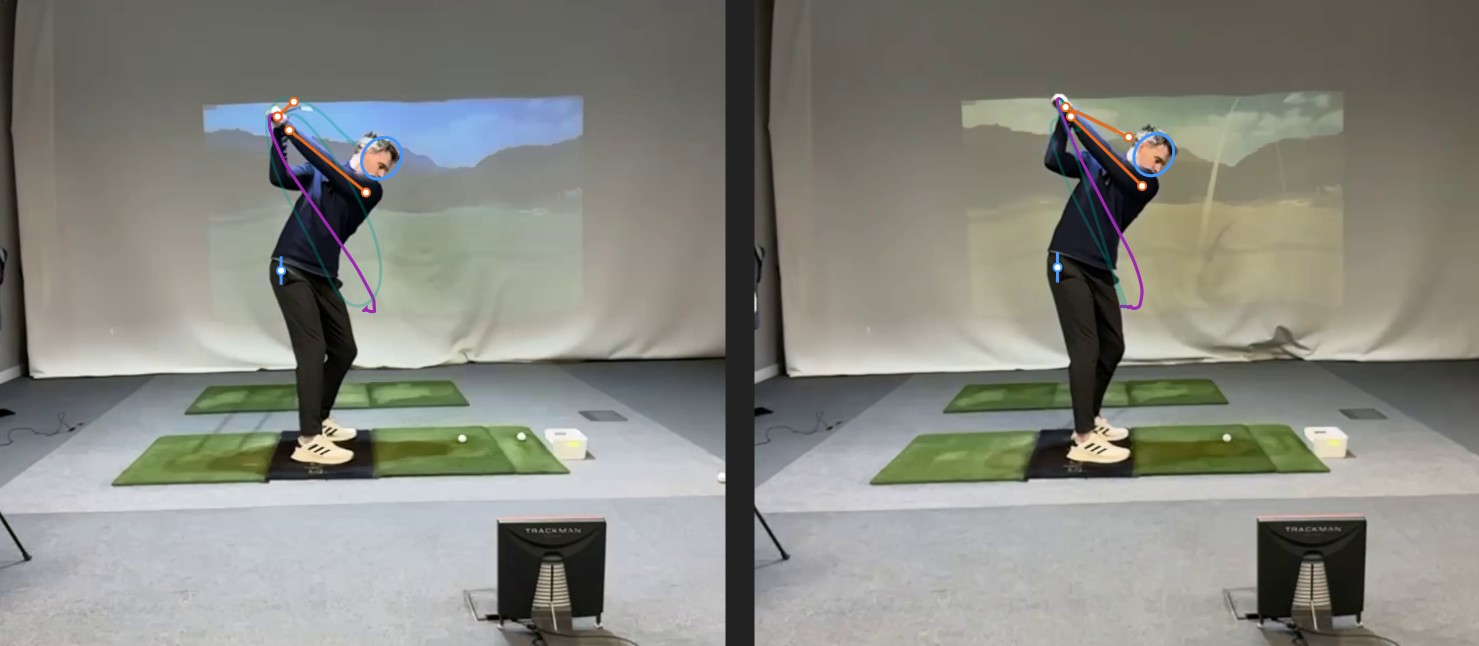
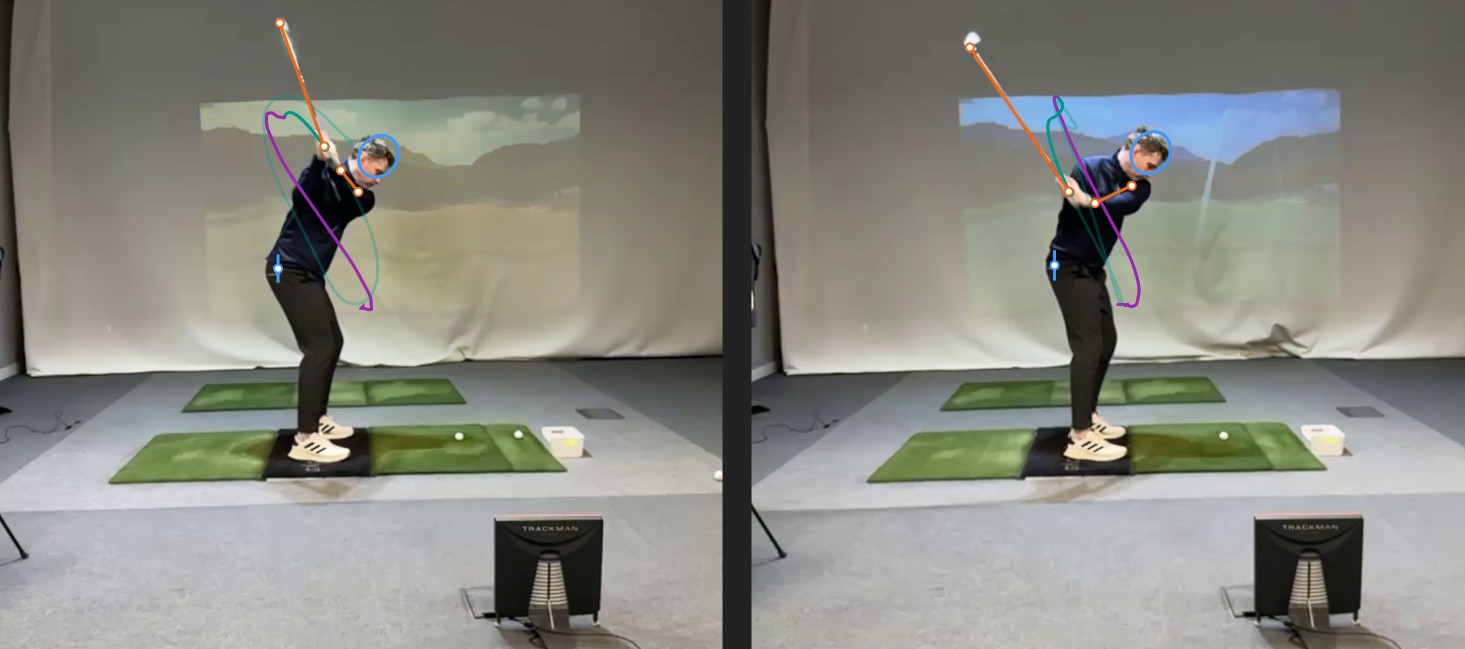
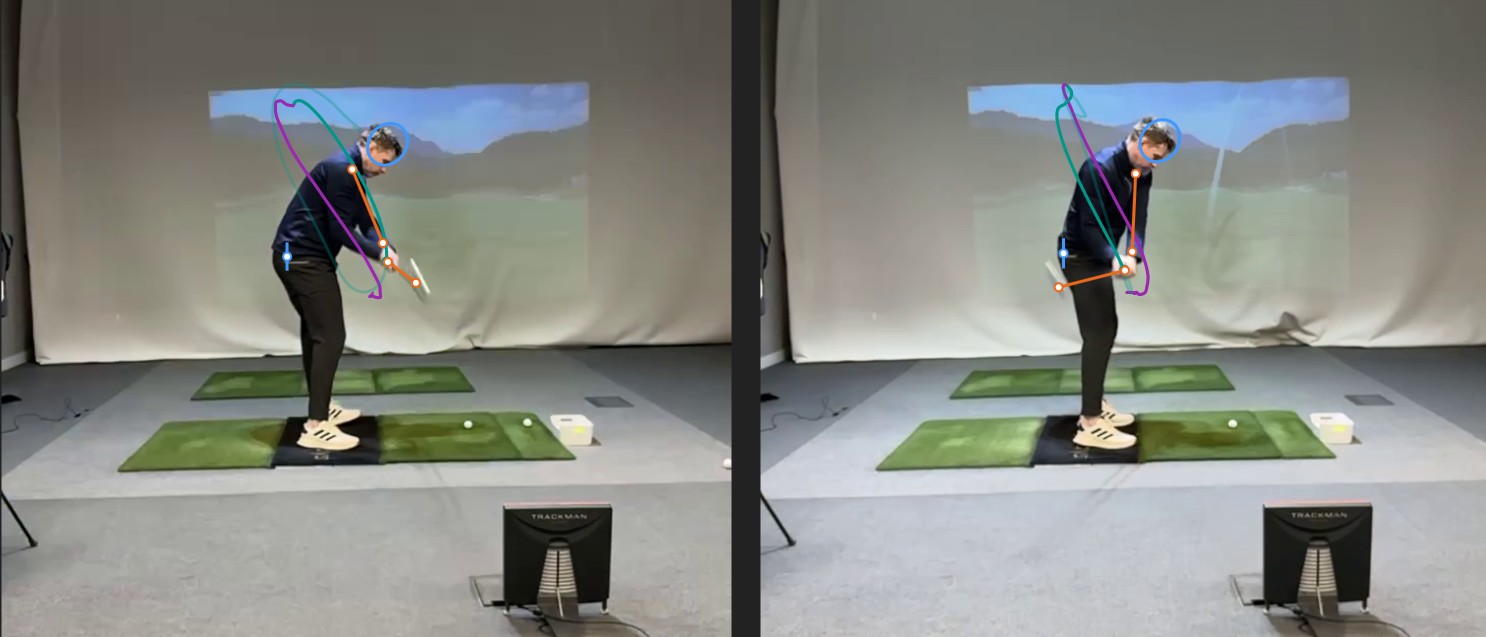
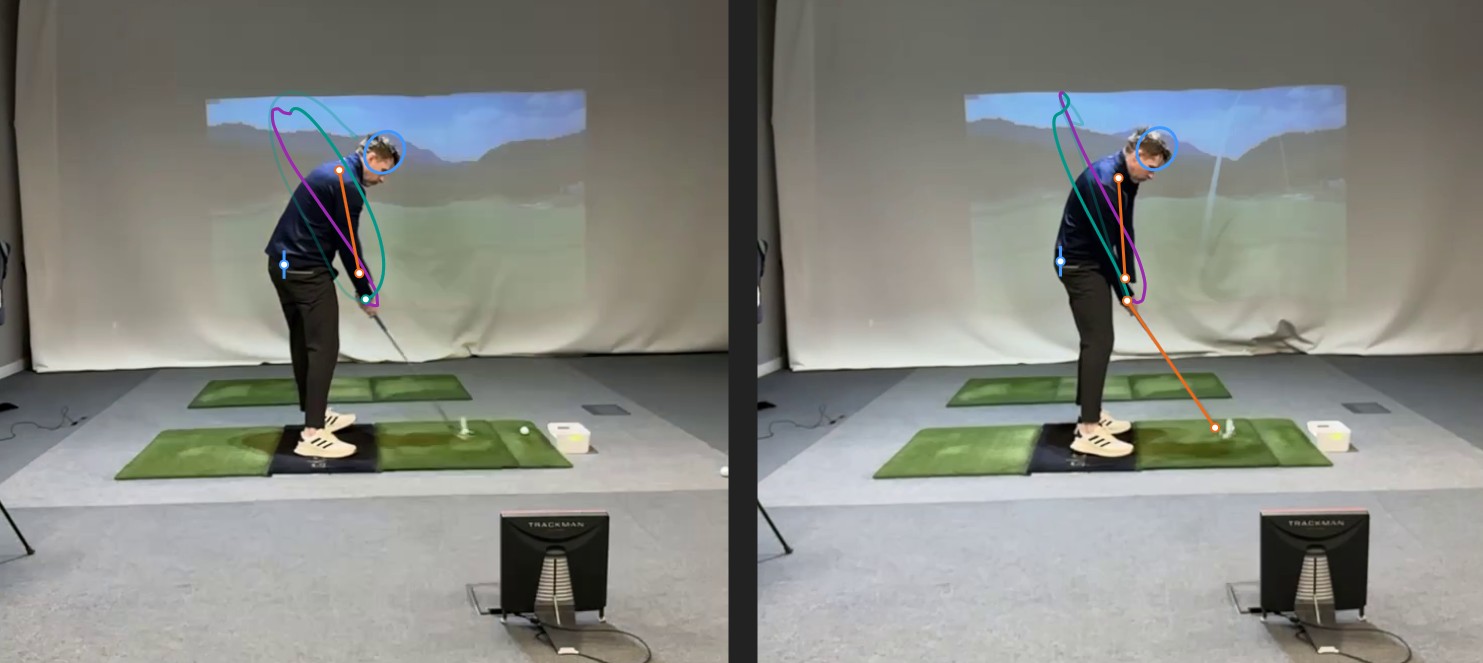
Several things are visible. First, the shaft orientation in the upper downswing carries too much steepness forward. Second, the hands work outward relative to the body instead of remaining committed to a more functional corridor around the torso. Third, as the club approaches impact, the geometry forces the clubhead into an across-the-ball pattern. The club is not the origin of the issue. The club is reporting the issue.
Why the student comes over the top
Over-the-top delivery is usually the body’s attempt to solve another problem. In some players the problem is timing. The body has not organised rotation, arm movement, and club mass early enough in transition, so the system uses the outward throw of the hands as the last available solution to get the club to the ball.
In some players the problem is perceptual. The golfer’s sense of where the club is in space is poor, so a more functional route feels too far behind, too trapped, or too risky. The player defaults to the path that feels most direct to the ball, even though it is mechanically destructive.
In some players the problem is emotional. The strike itself is treated as a threat event. The player wants certainty, contact, and immediacy. The nervous system responds by shortening time and space. It throws the system toward the ball instead of allowing delivery to unfold.
Very often the player experiences all three. This is why the pattern can persist even when the golfer understands the issue intellectually. Understanding is not the same as motor permission.
The psychological demand of the ball
The presence of the ball changes everything. Golfers often believe they are working on mechanics, but in reality they are working on mechanics under the demand of contact. The ball is not neutral. It introduces consequence, urgency, and the need to be right now.
When the golfer knows he must hit the ball, the movement system often compresses. Space disappears. Time feels shorter. The body moves toward the strike instead of allowing the strike to emerge from sequence. This is one of the most common hidden reasons the hands re-route over the top. The player is not necessarily trying to swing left. He is trying to guarantee contact.
Why this matters
Many golfers make far better rehearsal motions than real swings. In rehearsal there is no strike consequence. At the ball, the threat returns, and the old organisation takes over.
Why the correction feels exaggerated
One of the most important truths in motor change is that a new movement rarely feels proportionate to its actual size. When a golfer has repeated an over-the-top hand path for long enough, that route becomes normalised. It becomes the map of safety. Any movement that departs from it feels extreme.
A hand path that is only modestly deeper or more contained can feel absurdly exaggerated, as if the hands are being thrown miles behind the player. This is where many swing changes fail. The player judges the new route by feeling, not by reality. Because the reality map is distorted by the old habit, the player concludes that the correction must be wrong.
The key insight is simple: the new movement feels huge because the old movement had become invisible.
The foam noodle drill: what it really does
At first glance, the foam noodle looks like a simple obstacle drill. In reality it does several deeper things at once.
Mechanical function
- blocks the old outward hand-and-club route
- forces a more functional delivery corridor
- creates immediate feedback rather than delayed explanation
- teaches the player that a different route can still strike the ball
Perceptual and psychological function
- changes what space feels available
- reduces the dominance of the old safety map
- converts an abstract instruction into an external task
- builds belief that the new route is not dangerous
This is why the drill is not merely mechanical. It is a perceptual intervention. Instead of hearing “do not come over,” the student experiences a different route as a concrete requirement.
What the drill images show
In the drill sequence, the student is required to organise the hands and club in a way that no longer allows the previous outward throw. The noodle occupies the space that the old pattern depended on. This changes the task.
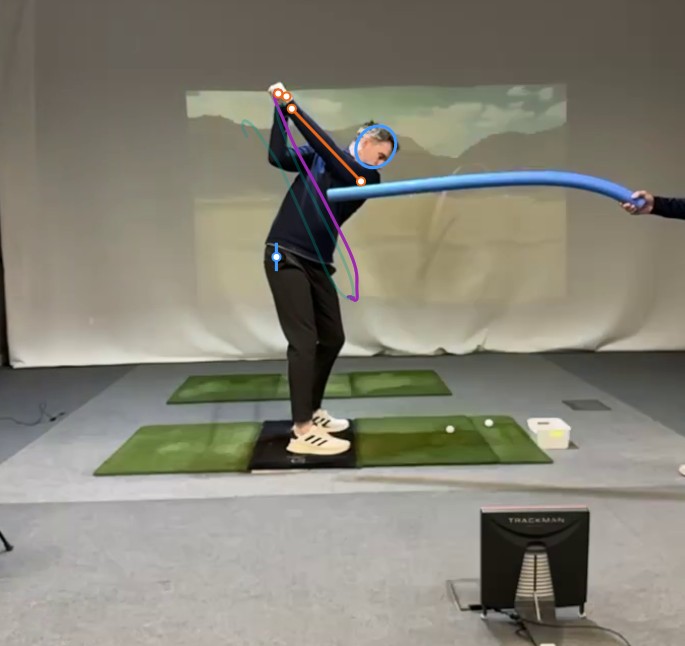
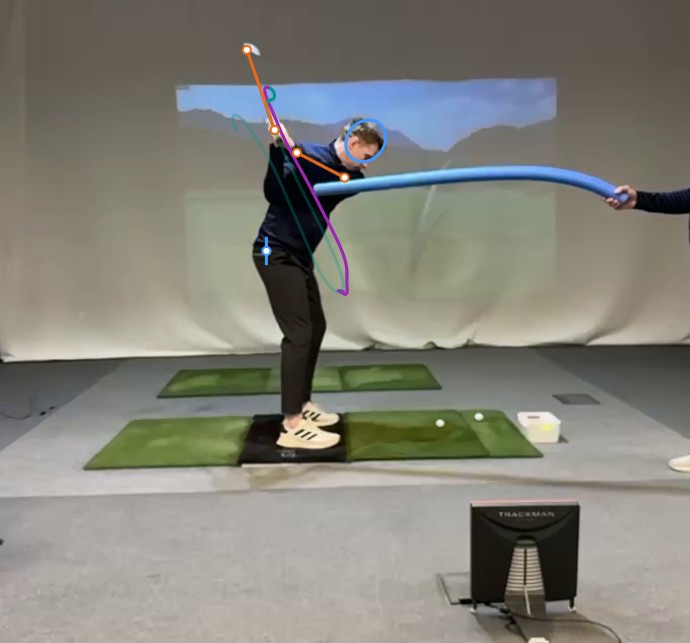
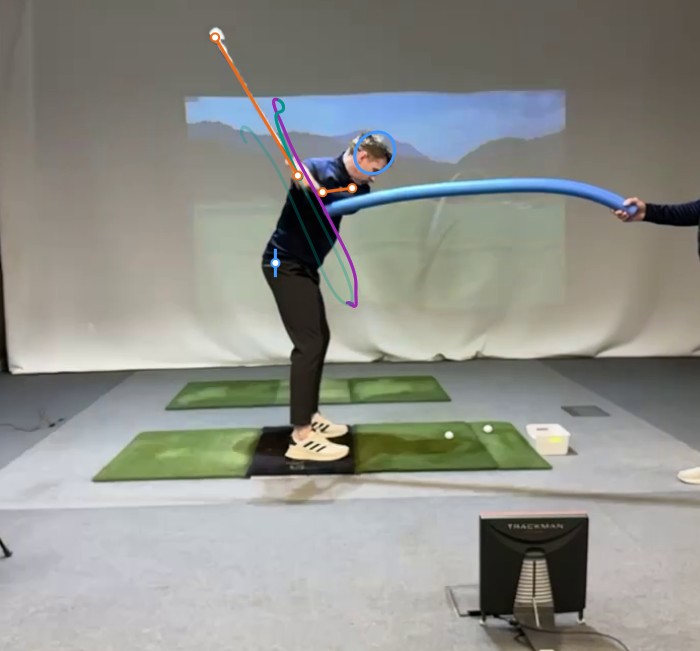
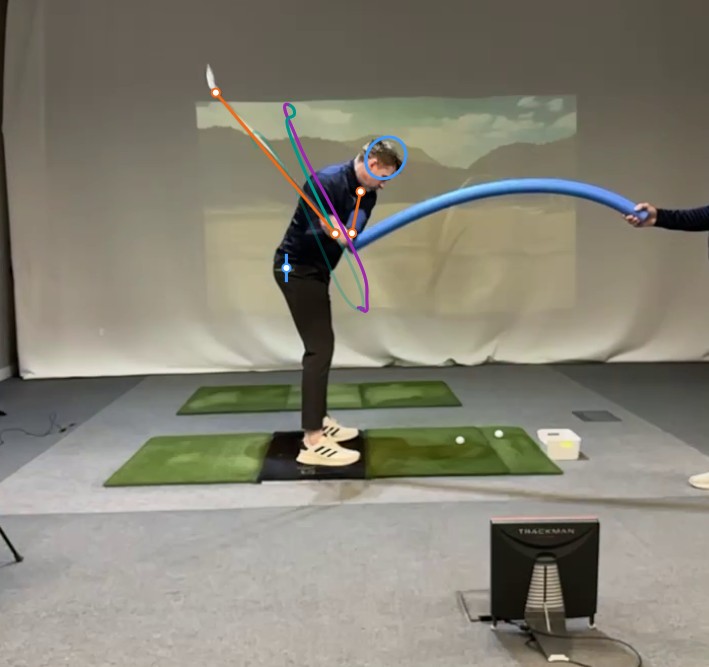
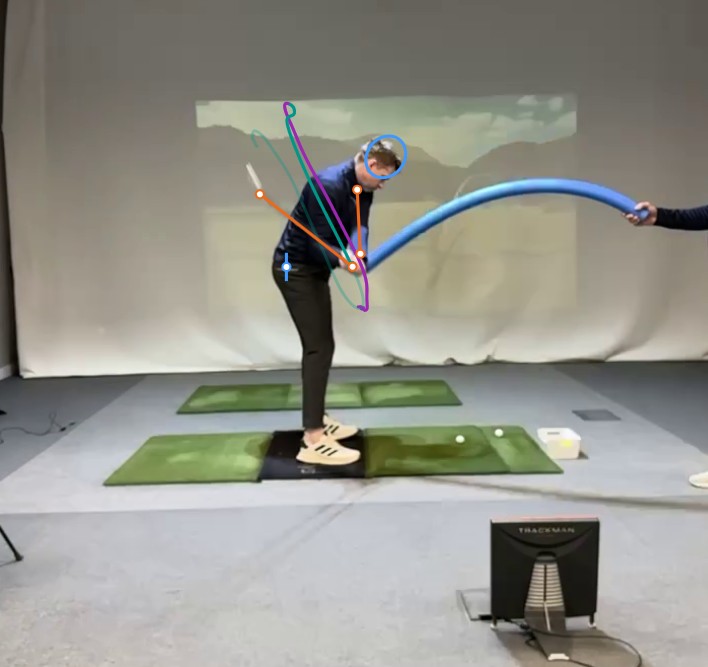
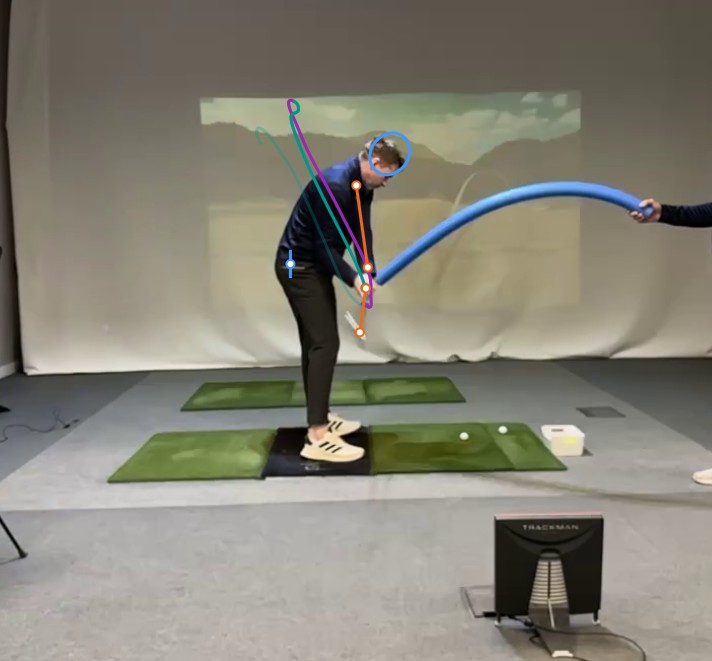
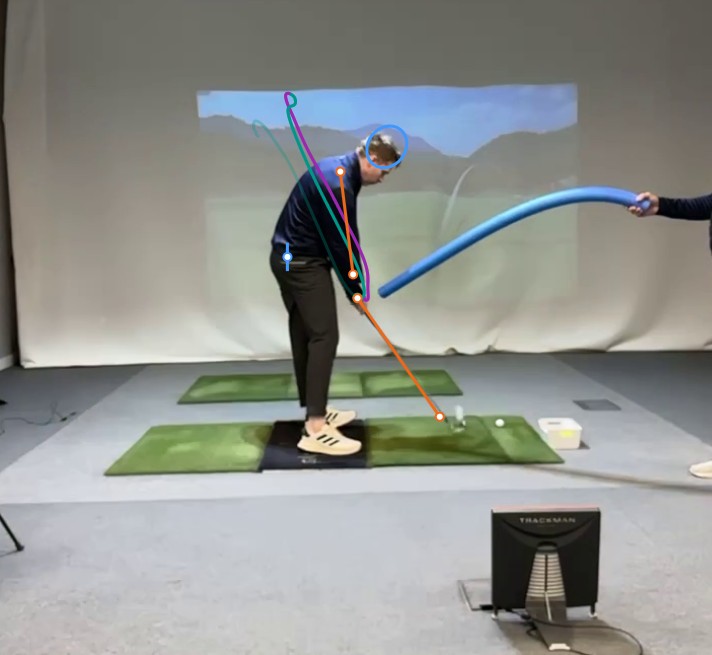
The hands are forced to remain on a corridor that is more compatible with rotational delivery. The club can then begin reorganising around them instead of being launched outward from them. This is not simply a matter of “shallowing the shaft.” The deeper change is that the student is learning a different relationship between torso, hands, and club.
The student’s felt experience
One of the most valuable parts of this intervention is the student’s reported feeling that the correction was immensely exaggerated. This is not a side note. It is central evidence.
It tells us that the old route had become so dominant that the new one was being interpreted as excessive. In reality, the change was not absurd. The hands were simply tracking the corridor they should have been using all along.
This gap between felt exaggeration and actual movement is one of the most important realities in golf coaching. If the coach does not prepare the student for it, the student will often reject the change. He will say it feels too much, too inside, too behind him, too late, or too strange. All of this may be true at the level of feeling. None of it proves the movement is wrong. It proves only that the old movement had become familiar.
Biomechanical sequencing and arm descent
One of the most misunderstood parts of over-the-top correction is the relationship between body motion and arm motion in transition. Serious golfers often understand one important truth: the body is the vessel that transports and builds energy. That is correct. Ground reaction force, pelvic rotation, thoracic motion, pressure shift, and segmental acceleration all contribute to the transport and expression of energy.
But many players then make a damaging leap in logic. They assume that because the body is the engine, the arms should simply be carried by the body. That is where many over-the-top patterns become locked in.
The body does transport the system, but the arms cannot become passive passengers. In a functional transition, the arms must begin moving downward relative to the torso while the body is rotating and transporting energy. This is not a contradiction. It is the essence of sequencing.
Critical principle
In many over-the-top golfers, the body does not fail because it moves too much. It fails because it moves without the arms descending enough relative to it.
Arms moving first in feel versus arms overtaking in reality
This point must be handled carefully because many golfers become frightened of the correct feel. When moving away from an over-the-top pattern, the golfer will often report that the arms feel as though they are starting first in transition. That feeling is common. It is also often necessary.
However, the feeling of the arms moving first does not mean the arms are truly outracing the body. Those are two completely different realities. If a golfer has spent months or years allowing the body to unwind while the arms remain suspended, then any meaningful restoration of arm descent will feel early. The nervous system has normalised lateness. Therefore, normal timing feels premature.
In reality, the arms are usually not overtaking the pelvis or thorax. They are simply no longer stalling. The golfer is not “throwing the arms from the top” in the destructive sense. He is restoring the downward transport of the arm unit so the body’s rotation has something functional to rotate around.
What happens when the arms stall while the body moves
When the arms fail to descend sufficiently in transition while the pelvis and thorax begin to rotate, several predictable biomechanical consequences appear.
- Loss of vertical reorganisation: the arm unit remains elevated for too long.
- The chest opens underneath suspended arms: the sternum and lead shoulder move away while the arm unit remains late.
- The shaft pitch remains too steep for too long: the club has insufficient opportunity to reorganise behind the hands.
- The golfer runs out of space: over the top is often a space problem before it is a path problem.
- The system chooses an outward hand throw: the golfer still needs to reach the ball, so the old rescue pattern appears.
At that point the outward hand throw is not random. It is the body’s emergency strike solution.
Why the arms must move down relative to the torso
The word “independently” is often misunderstood. It does not mean the arms act in isolation from the body. It means the arms must possess their own functional downward transport rather than waiting passively for torso rotation to deliver them.
In a high-level swing, the pelvis shifts and begins to open, the thorax responds with its own timing, and the arms are being transported by the body while also changing position relative to the torso. That relative movement is what many golfers miss.
The arms are not fixed to the ribcage like rigid appendages. They are suspended segments with mass, inertia, and muscular control. Their relationship to the trunk must change in transition. If it does not, the geometry deteriorates.
This is why a golfer can be “using the body well” in a broad sense and still come over the top. The body may be producing force. The body may be rotating. The body may even be opening aggressively. But if the arm unit is not descending relative to that moving trunk, the force is being transported into a poor delivery structure.
The stretch the golfer often feels during correct change
When the golfer begins to correct an over-the-top hand path by allowing the arms to descend properly while the body continues transporting and rotating, he will often feel a stretch that seems unusual, intense, or even alarming.
This sensation is commonly perceived through some combination of the latissimus region, the trail-side posterior shoulder, the area around the trail scapula, the lead-side chest and upper-arm connection, and the oblique-rib interface as the torso opens while the arm unit remains better organised.
Why does this happen? Because the golfer is finally creating separation with function, not just visual separation. In many over-the-top players, the system loses the elastic organisation between torso transport and arm descent because the hands are thrown outward too soon. The chain collapses early. When the correction is made, the player often feels as if the body is moving while the arms are “staying back” or “dropping under.” In reality, he is often feeling a more truthful loading relationship between trunk motion and arm transport.
Why “use the body” can be dangerous advice
Many golfers with over-the-top issues have been damaged by well-meaning but incomplete advice. They are told:
- “Start from the ground.”
- “Open the hips sooner.”
- “Clear harder.”
- “Use your body, not your arms.”
Each of these can be directionally useful in the right context. But in an over-the-top hand-path pattern, they can intensify the error if the arm descent issue is not solved simultaneously.
If the golfer simply rotates harder while the arms remain suspended, he often creates more chest opening under late arms, more steep shaft carryover, more outward hand throw, and more across-ball delivery. This is why sequencing must be explained as coordinated descent plus transport, not as “body first” in a crude sense.
The psychological trap of thinking the arms are taking over
Once the golfer begins to feel the arms descend more effectively in transition, a common fear appears. He believes he is now becoming “too arm-driven.” This fear is understandable because the felt experience is strong. The arms now seem active. They seem present. They no longer feel passive.
To a golfer who has been told for years not to use the arms, this can feel like regression. But the coach must explain the difference between reactive arm descent that preserves delivery space and destructive arm throw that overtakes sequence. These are not the same movement.
In most over-the-top corrections, the golfer is not suddenly becoming too arm-driven. He is simply allowing the arms to participate at the time they should have been participating all along.
The coaching line that matters
What feels like “the arms taking over” is often only the removal of a stall.
How this connects back to the noodle drill
The foam noodle drill becomes even more powerful when understood through sequencing rather than only through path. The noodle does not merely stop the club from moving outward. It also forces the golfer to solve the sequencing problem differently.
If the golfer tries to unwind the body while leaving the arms high and stalled, the old outward hand route becomes the available rescue pattern and the noodle blocks it. Therefore, to succeed, the golfer must begin allowing the arms to descend in a more functional relationship to the rotating body.
This is why the drill can create such a strong perceptual and emotional response. The golfer is not only avoiding an object. He is being forced to reorganise the timing relationship between trunk transport and arm descent.
How this article fits the swing-plane cluster
This article sits inside a broader topic cluster on delivery, hand path, and impact geometry. It connects directly to Optimum Biomechanical Swing Plane, which explains how a stable hand corridor and club-mass organisation produce a functional delivery plane, and to The Myth of the Single Swing Plane, which explains why golfers should stop treating plane as one static visual line.
Together, these articles tell Google and the reader that this site does not treat swing plane as isolated advice. It treats it as part of a connected biomechanical system involving hand path, sequencing, release, dynamic lie, and perception.
Practical summary
The over-the-top pattern is often mislabelled as a steep-club problem when the deeper issue is an over-the-top hand path. The hands re-route outward, the body and arms lose synchronisation, the shaft stays steep too long, and the club is then forced into an across-the-ball rescue pattern.
Correcting it requires more than a visual instruction. It requires diagnosis of the hand corridor, understanding of how the ball creates urgency and threat, recognition that the arms must descend relative to the moving torso, and enough perceptual training for the new route to stop feeling absurdly exaggerated.
The foam noodle drill works because it changes what the golfer perceives as available. It teaches that the new route still allows contact, and in doing so it changes not only the movement but the belief attached to the movement.
If you want the broader foundations behind this article, read Optimum Biomechanical Swing Plane and The Myth of the Single Swing Plane. Those companion pieces make the topic cluster stronger for readers and for search engines, and they clarify how hand path, delivery plane, and impact geometry belong to the same biomechanical conversation.
Work with Chris Brook
If you want your hand path, delivery, and sequencing diagnosed properly rather than guessed at through generic swing tips, the process begins with identifying the real constraint: arm descent, body transport, delivery corridor, perception, or threat under strike.
UK studio sessions and online coaching for international players. Diagnostics integrate biomechanics, perception, psychology, and performance behaviour.